
Welcome to this complete guide on answering one of the biggest questions homeowners face: is it cheaper to renovate or demolish and rebuild? When your current home no longer suits your lifestyle, budget, or future plans, choosing between renovating and starting again can feel overwhelming. The right decision depends on your property’s condition, the scale of work required, local building costs, planning rules, and the long-term value you want to achieve. This guide breaks down the key cost factors, benefits, risks, and practical considerations so you can compare both options with confidence and make a smarter, more informed decision before speaking with builders, designers, or renovation experts.
It is usually cheaper to renovate if the existing home is structurally sound and only needs cosmetic or functional upgrades. Demolishing and rebuilding may be more cost-effective when the property has major structural issues, outdated systems, poor layout, or renovation costs close to new build costs.
- Understanding The Difference Between Renovating And Rebuilding
- Is It Generally Cheaper To Renovate Or Demolish And Rebuild?
- Key Factors That Influence The Cost Difference
- Cost Comparison Renovation Vs Rebuild
- Advantages Of Renovating An Existing Home
- Advantages Of Demolishing And Rebuilding
- Warning Signs That Rebuilding May Be The Better Option
- When Renovating Is Usually The Smarter Choice
- Questions To Ask Before Making A Decision
- Expert Advice For Comparing Renovation And Rebuild Costs
- References
- FAQs: About Is It Cheaper to Renovate Or Demolish And Rebuild
- Conclusion
- Find A Professional Renovator’s Company Near You!
Understanding The Difference Between Renovating And Rebuilding
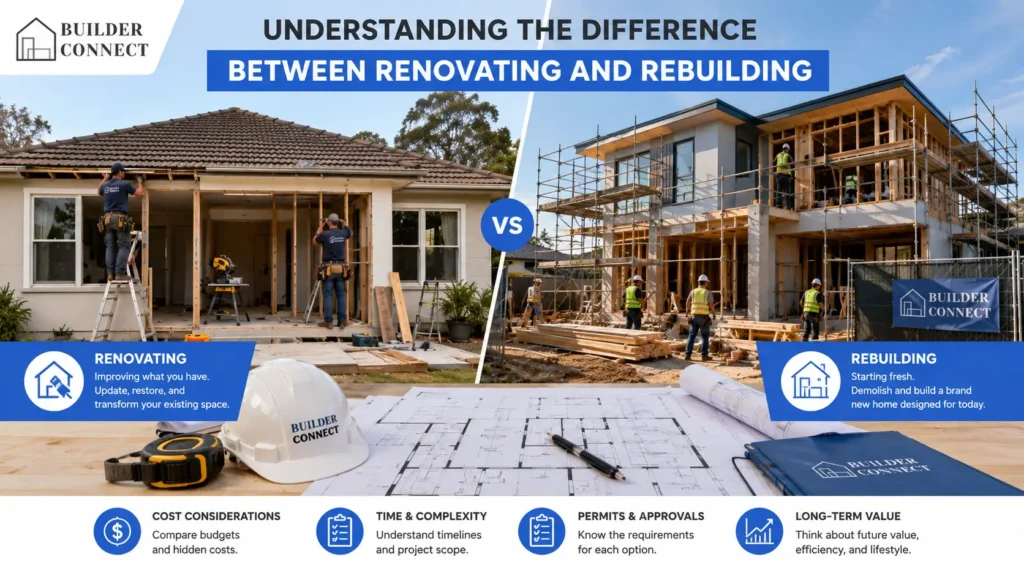
When deciding whether it is cheaper to renovate or demolish and rebuild, the first step is understanding what each option actually involves. Renovating usually means improving, repairing, or expanding the existing home, while rebuilding means removing the current structure and starting again with a new-home design. Both choices can improve comfort, function, and property value, but they come with very different cost factors, timelines, approval requirements, and long-term outcomes.
What Counts As A Renovation?
A renovation can be simple or complex depending on how much of the existing home is being changed. In many cases, homeowners choose renovation because they want to keep the original structure while improving the way the home looks, feels, and functions. This can be a cost-effective option when the house is structurally sound and the required changes are not too extensive.
- Cosmetic Renovations: These are surface-level improvements that update the appearance of a home without changing its structure. Common examples include painting, new flooring, updated lighting, modern fixtures, cabinetry upgrades, and refreshed interior finishes. Cosmetic renovations are usually the most affordable option because they do not involve major building work.
- Partial Home Remodels: A partial remodel focuses on one or more areas of the home, such as the kitchen, bathroom, laundry, or living area. This type of renovation can improve daily comfort and increase resale appeal without requiring a full-house transformation. Costs can rise when plumbing, electrical, or layout changes are involved.
- Major Structural Renovations: Structural renovations involve changing important parts of the home, such as walls, foundations, rooflines, framing, or load-bearing elements. These projects require careful planning, professional advice, and often council approvals. They can become expensive because they may uncover hidden issues once work begins.
- Extensions And Additions: Extensions and additions increase the size of the home by adding new rooms, expanding living spaces, or building upward with a second-storey addition. This can be a smart choice when the existing home has good bones but lacks space. However, the cost can become similar to rebuilding if the addition requires major foundation work, roof changes, or extensive structural upgrades.
What Does Demolishing And Rebuilding Involve?
Demolishing and rebuilding is a much larger process than renovating because it starts with removing the existing home and creating a new one from the ground up. This option gives homeowners more design freedom, but it also involves more planning, approvals, and upfront investment. It may be the better long-term choice when the current home has serious structural problems, an impractical layout, or outdated systems that would be costly to repair.
- Demolition Process: Demolition involves safely removing the existing structure, clearing materials, and managing waste. Before demolition begins, professionals may need to assess asbestos, hazardous materials, utility disconnections, neighbouring-property impacts, and site-access limitations. These factors can affect both cost and timeline.
- Site Preparation: Once the old home is removed, the land must be prepared for construction. Site preparation may include excavation, levelling, drainage work, soil testing, foundation planning, and service connections. A difficult or sloping site can increase costs because it may require extra earthworks or specialised engineering.
- New Home Construction: Rebuilding allows the homeowner to design a new-home layout that better suits current and future needs. This can include open-plan living, improved insulation, energy-efficient systems, better storage, modern materials, and a more functional floor plan. While the upfront cost is often higher than a basic renovation, the finished home may provide better long-term value and lower maintenance costs.
- Compliance And Approvals: A rebuild usually requires building consent, planning approval, inspections, engineering input, and compliance with current building standards. These steps help ensure the new home is safe, durable, and legally constructed. Approval requirements can add time to the project, but they also protect homeowners from costly compliance issues later.
Why Homeowners Consider Both Options
Many homeowners compare renovation and rebuilding because their current home no longer fits their lifestyle, but they still want to make the most of their property. The right decision depends on the condition of the existing house, the cost of the desired improvements, local building rules, and the homeowner’s long-term plans. A professional assessment is often helpful because two homes with similar age and appearance can have very different renovation potential.
- Outdated Layouts: Older homes often have closed-off rooms, small kitchens, limited storage, poor indoor-outdoor flow, or inefficient use of space. Renovation may solve these issues if the structure allows for layout changes. Rebuilding may be more practical when the existing layout is too restrictive or expensive to alter.
- Growing Family Needs: Families often need more bedrooms, larger living areas, better bathrooms, or flexible spaces for working from home. Renovating can work well when extra space can be added efficiently. Rebuilding may be better when the current home cannot comfortably support future lifestyle needs.
- Structural Concerns: Foundation movement, water damage, termite damage, roof deterioration, and ageing electrical or plumbing systems can make renovation more complicated. If repair costs keep growing, demolishing and rebuilding may offer a cleaner, safer, and more predictable path forward.
- Property Value Improvements: Both renovation and rebuilding can increase property value when done well. Renovation may deliver strong returns when updates are targeted and cost-controlled. Rebuilding may create higher value when the new home better matches buyer expectations, modern living standards, and the value of the land.
Understanding the difference between renovating and rebuilding helps homeowners compare more than just the starting price. A renovation may be cheaper when the existing home is strong and the changes are manageable, while a rebuild may offer better long-term value when the property needs major repairs or a completely new design. The smartest choice comes from balancing budget, lifestyle, condition, approvals, and future resale potential.
Is It Generally Cheaper To Renovate Or Demolish And Rebuild?
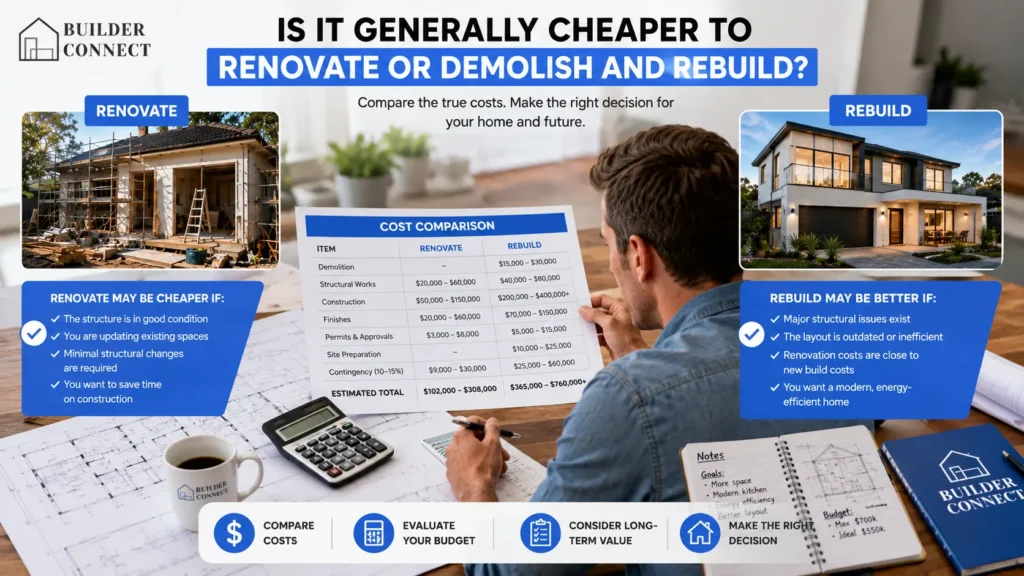
In most cases, renovating is cheaper than demolishing and rebuilding when the existing home is structurally sound and the changes are mostly cosmetic or functional. However, the cheapest option is not always the best long-term choice. If a home has serious structural problems, outdated systems, or a layout that no longer works, a full rebuild may provide better value over time.
Situations Where Renovating Is Usually More Affordable
Renovating is often the more cost-effective option when the main structure of the home is still in good condition. If the foundation, framing, roof, and major systems are reliable, homeowners can often improve comfort, style, and function without taking on the higher cost of demolition and new construction.
- Sound structural foundations: If the home has strong foundations and no major movement, cracking, or drainage-related damage, renovation usually makes more financial sense. A solid structure gives builders a reliable base to work from, reducing the need for expensive structural repairs.
- Limited layout changes: Renovation is usually cheaper when walls, plumbing, and electrical systems can stay mostly in place. Moving kitchens, bathrooms, staircases, or load-bearing walls can quickly increase costs because these changes often require specialist trades, engineering advice, and council approvals.
- Modernizing finishes and fixtures: Updating flooring, cabinetry, lighting, paint, benchtops, bathrooms, and kitchens can dramatically improve a home without the cost of starting from scratch. These cosmetic and functional upgrades are often enough when the home already has a practical layout.
- Preserving existing building elements: Renovation can be especially worthwhile when the home has valuable character features, quality timber, high ceilings, original brickwork, or established architectural details. Keeping these existing elements can save money while maintaining charm and resale appeal.
Situations Where Rebuilding May Save Money Long-Term
Demolishing and rebuilding can cost more upfront, but it may be the smarter financial decision when renovation would only patch deeper problems. In some cases, homeowners spend heavily on upgrades but still end up with an inefficient, high-maintenance home that does not fully meet modern living standards.
- Severe structural damage: If the home has foundation failure, major water damage, termite damage, extensive rot, or serious framing issues, repair costs can become unpredictable. Rebuilding may give homeowners a safer, stronger, and more reliable result.
- Extensive renovations required: When almost every part of the home needs work, renovation costs can come close to the price of a new build. Full-home renovations involving structural changes, new services, extensions, and major repairs often carry higher risk because hidden problems may appear once work begins.
- Outdated building systems: Older homes may have aging plumbing, unsafe wiring, poor insulation, inefficient heating, or non-compliant drainage. Replacing these systems during a renovation can be expensive, especially when access is difficult or walls and floors need to be opened.
- High ongoing maintenance costs: A renovated older home may still need regular repairs if the roof, cladding, windows, drainage, or subfloor remain in poor condition. A new build can reduce maintenance costs, improve energy efficiency, and provide modern materials with product warranties.
The Hidden Costs Many Homeowners Overlook
The real cost of renovating or rebuilding is not limited to builder quotes. Homeowners should also consider temporary living arrangements, approval fees, design changes, unexpected repairs, and delays. These hidden costs can affect the final budget and should be factored in before choosing a direction.
- Temporary accommodation: Major renovations and rebuilds may require the family to move out during construction. Rent, storage, moving costs, and extra travel can add a significant amount to the overall project budget.
- Unexpected structural issues: Renovations often reveal problems that were not visible during the first inspection, such as hidden water damage, poor framing, asbestos, or outdated wiring. These issues can lead to variation costs and timeline changes.
- Permit and approval costs: Renovations involving structural changes, extensions, plumbing, drainage, or demolition may require council approvals, engineering reports, design documentation, and inspections. These professional and compliance-related costs should be planned early.
- Project delays: Weather, material shortages, consent delays, contractor availability, and unexpected site conditions can all extend the project timeline. Delays may increase labour costs, accommodation expenses, and overall stress for homeowners.
The best way to decide whether renovating or rebuilding is cheaper is to compare both options using detailed quotes, a professional property assessment, and a realistic long-term budget. Renovation may be the better choice for a sound home with manageable updates, while rebuilding may offer better value when the existing structure is costly to repair or no longer supports the way you want to live.
Key Factors That Influence The Cost Difference
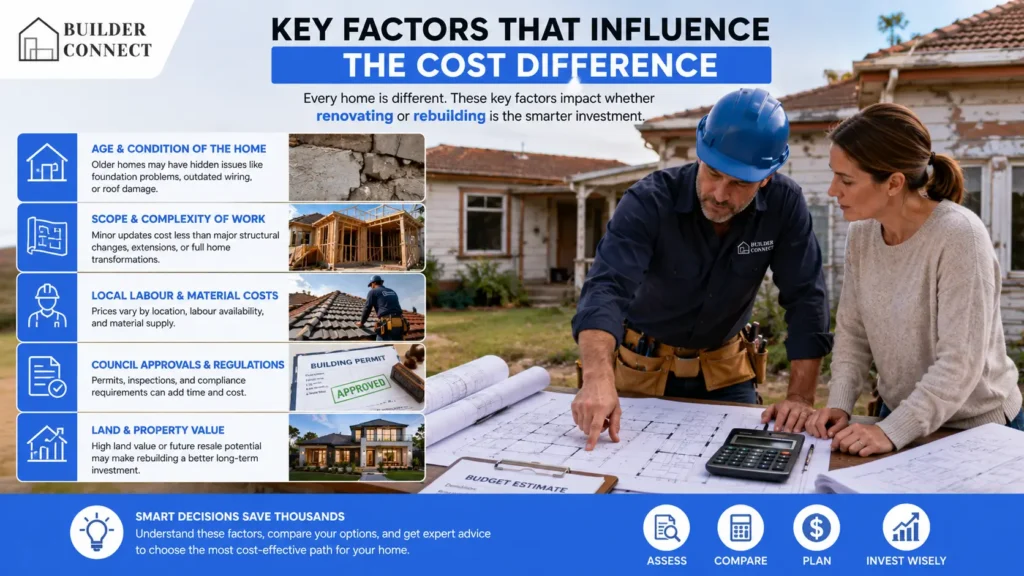
The cost difference between renovating and demolishing to rebuild is rarely based on one simple figure. It usually comes down to the existing home’s condition, the amount of work required, local construction costs, and the long-term value of the land. Understanding these factors can help homeowners make a more informed decision instead of choosing the option that only appears cheaper at first.
Age And Condition Of The Existing Home
The older a property is, the more carefully it needs to be assessed before deciding whether to renovate or rebuild. A home may look manageable from the outside, but hidden structural, roofing, plumbing, or electrical issues can quickly turn a straightforward renovation into a high-cost project.
- Foundation issues: Cracked, shifting, or uneven foundations can make renovation more expensive because the home may need structural repairs before any cosmetic upgrades can begin.
- Roof condition: An ageing roof can add significant cost, especially if there is water damage, sagging, poor insulation, or damaged framing beneath the surface.
- Plumbing and electrical systems: Older homes often have outdated wiring, corroded pipes, or systems that no longer meet current safety standards, which can increase renovation costs.
- Building code compliance: Renovations may trigger the need to upgrade parts of the home to meet current building-code requirements, especially when structural changes or major system upgrades are involved.
Scope Of Work Required
The size and complexity of the project will heavily influence whether it is cheaper to renovate or demolish and rebuild. A simple update is usually more affordable than starting from scratch, but a full-home transformation can become expensive if it involves major structural changes.
- Minor upgrades vs full transformation: Cosmetic updates such as painting, flooring, cabinetry, and fixture replacement are usually much cheaper than rebuilding. However, if the goal is to completely change the layout, add rooms, or modernise most of the home, the cost gap can narrow quickly.
- Structural modifications: Removing load-bearing walls, strengthening framing, or reworking the internal layout often requires engineering advice, council approvals, and specialist labour.
- Extensions and second-storey additions: Adding floor space can be costly because it may require foundation upgrades, roof alterations, drainage changes, and careful integration with the existing structure.
Local Construction And Labour Costs
Construction costs vary from one location to another, and these differences can affect both renovation and rebuild budgets. Labour availability, material pricing, transport costs, and regional demand all play a role in the final project cost.
- Regional cost variations: Building in a high-demand area often costs more because contractors, materials, and trades may be harder to secure.
- Material availability: Shortages or long delivery times can increase costs, especially for specialised materials, custom finishes, or imported products.
- Skilled labour demand: Renovations often require experienced trades who can work around existing structures, which may cost more than standard new-build work.
Land And Property Value Considerations
The value of the land should be part of the decision, especially in desirable locations where a new home may significantly improve the property’s resale appeal. In some cases, the land itself is worth more than the existing dwelling, which can make rebuilding a smarter long-term investment.
- Neighbourhood trends: If nearby homes are being rebuilt or significantly upgraded, a new build may better match buyer expectations in the area.
- Future resale potential: A modern, energy-efficient home with a functional layout may attract stronger buyer interest than an older renovated property with ongoing maintenance concerns.
- Investment value: Renovating can protect character and reduce upfront costs, while rebuilding can offer better design flexibility, lower maintenance, and stronger long-term property value.
The cheapest option is not always the best-value option. A careful comparison should look beyond the initial quote and consider hidden repairs, future maintenance, resale potential, and how well the finished home will support the owner’s lifestyle over time.
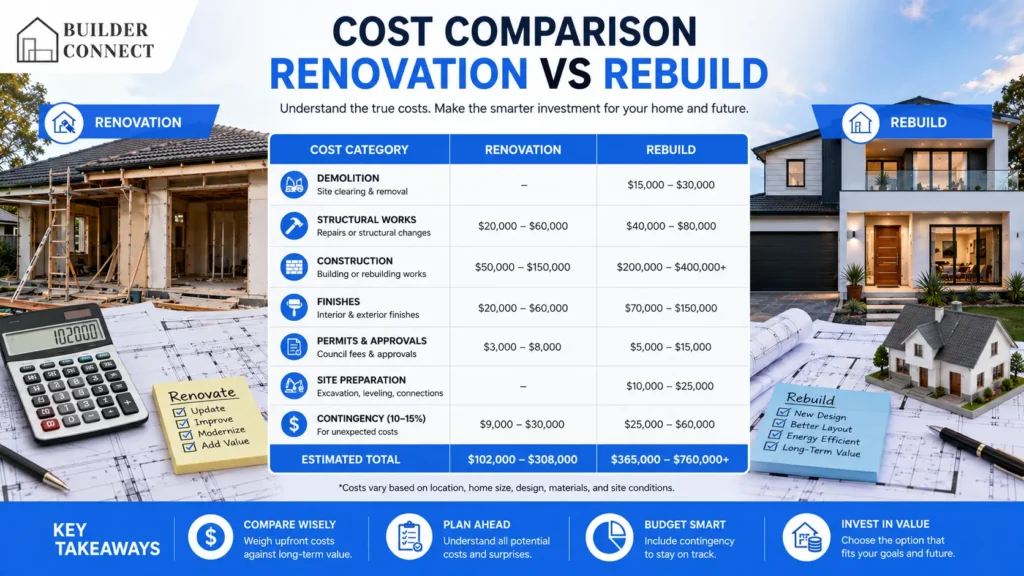
Cost Comparison Renovation Vs Rebuild
Understanding the cost difference between renovation and rebuilding is one of the most important steps before making a major home-improvement decision. While renovating can seem cheaper at first, the final cost depends on the home’s age, structural condition, design goals, labour costs, approval requirements, and how much hidden repair work is uncovered once the project begins.
Typical Renovation Cost Ranges
Renovation costs can vary widely because not every renovation involves the same level of work. A simple refresh may only update the look of a home, while a large-scale renovation can involve structural changes, new services, and major layout improvements.
- Cosmetic renovations: Cosmetic work is usually the lowest-cost option because it focuses on surface-level improvements rather than structural changes. This may include painting, flooring, cabinetry updates, lighting upgrades, benchtop replacement, or minor bathroom and kitchen improvements. These projects can improve comfort and appearance without changing the home’s footprint.
- Mid-range renovations: A mid-range renovation usually involves more detailed updates, such as replacing kitchens, bathrooms, windows, internal walls, or outdated plumbing and electrical systems. Costs increase because the work often requires licensed trades, permits, and more careful planning. This option is common when the home is generally sound but needs functional upgrades.
- Extensive whole-home renovations: A whole-home renovation can become expensive because it may involve structural alterations, layout changes, extensions, roofing, insulation, drainage, and service upgrades. Once a project reaches this level, homeowners should compare renovation quotes against demolition and rebuild costs to avoid overspending on a house that may still have long-term limitations.
Typical Demolition And Rebuild Cost Ranges
Demolishing and rebuilding is usually a larger upfront investment, but it can provide better long-term value when the existing home has serious structural problems or no longer suits modern living needs. Instead of working around old materials, outdated layouts, and hidden defects, a rebuild allows homeowners to start with a new design and current building standards.
- Demolition expenses: Demolition costs include safely removing the existing structure, clearing debris, disconnecting services, and managing waste disposal. Costs may rise if the property contains hazardous materials, difficult access, asbestos, or structures that require specialist removal.
- Site works: Site preparation can include excavation, levelling, drainage, retaining, soil testing, foundation preparation, and service connections. These costs are often overlooked, but they can have a major impact on the total rebuild budget, especially on sloped, restricted, or poor-drainage sites.
- Construction costs: New-home construction costs depend on the size of the build, materials, design complexity, labour rates, and finish level. A standard design is usually more cost-effective than a highly customized home, while premium fixtures, architectural details, and complex layouts will increase the final price.
Comparing Short-Term Costs And Long-Term Value
The cheapest option on paper is not always the best financial decision. Renovation may reduce the initial spend, but rebuilding can sometimes deliver better value through lower maintenance, improved energy performance, stronger resale appeal, and fewer future repair risks.
- Upfront investment: Renovating often has a lower upfront cost when the home is structurally sound and only needs targeted upgrades. Rebuilding usually requires more money at the beginning because it includes demolition, site preparation, approvals, and full construction.
- Maintenance costs: Older homes can continue to require repairs even after renovation, especially if roofing, plumbing, wiring, drainage, or foundations are nearing the end of their service life. A new build typically reduces near-term maintenance because the materials, systems, and fixtures are new.
- Energy-efficiency savings: Rebuilding gives homeowners the chance to include modern insulation, better glazing, efficient heating and cooling, improved ventilation, and energy-smart appliances from the start. Renovations can improve energy efficiency too, but older building structures may limit how far upgrades can go.
- Future repair risks: Renovations can uncover hidden issues once walls, floors, or ceilings are opened. Problems such as water damage, rot, non-compliant wiring, or poor past workmanship can increase costs quickly. A rebuild offers more certainty because the home is constructed from the ground up using new materials and current standards.
When comparing renovation vs rebuild costs, the right choice depends on more than the initial quote. Homeowners should look at the full picture, including current property condition, long-term maintenance, energy performance, lifestyle needs, and resale potential before deciding which option offers the strongest overall value.
Advantages Of Renovating An Existing Home
Renovating an existing home can be a practical and cost-conscious option when the property has a solid structure, a layout that can be improved, and features worth keeping. For many homeowners comparing whether it is cheaper to renovate or demolish and rebuild, renovation offers a way to upgrade comfort, function, and value without starting from scratch.
Lower Initial Costs In Many Cases
Renovating is often more affordable upfront because you are working with the home’s existing structure rather than paying to remove it and build an entirely new property. If the foundations, framing, roofline, and major services are in good condition, keeping these elements can reduce the overall project cost.
- Preserving Existing Structure: Keeping usable parts of the home, such as the walls, slab, roof framing, or established layout, can reduce material and labour costs compared with a full rebuild.
- Reduced Demolition Expenses: Demolition involves more than knocking down a house. It can include permits, waste removal, asbestos handling, disconnection of services, site-clearing work, and preparation for a new build.
Faster Project Timelines
A well-planned renovation can often be completed faster than demolishing and rebuilding, especially when the work focuses on kitchens, bathrooms, flooring, interior layouts, or cosmetic upgrades. While larger renovations still require careful project management, they may avoid some of the longer approval and construction stages linked to a brand-new home.
- Less Extensive Construction Work: Renovations usually involve improving selected parts of the property instead of rebuilding every structural, mechanical, and finishing element from the ground up.
- Reduced Approval Requirements: Depending on the scope of work, some renovations may need fewer council approvals than a full demolition-and-rebuild project, although structural changes and extensions still require professional review.
Retaining Character And Architectural Features
One of the biggest advantages of renovating is the ability to keep the features that make an older home unique. Many existing homes have character details, mature landscaping, established street appeal, or period-style craftsmanship that can be difficult or expensive to recreate in a new build.
- Heritage Homes: Renovation can help preserve original features such as timber floors, detailed ceilings, brickwork, fireplaces, or traditional facades while improving comfort and functionality.
- Established Neighbourhood Appeal: Older homes are often located in well-established areas with mature trees, developed infrastructure, and strong community appeal, which can add long-term value.
Reduced Environmental Impact
Renovating can be the more environmentally responsible choice when the existing home is structurally sound. Reusing parts of the building reduces the demand for new materials and helps limit the amount of construction waste sent to landfill.
- Reusing Existing Materials: Keeping usable framing, flooring, bricks, fixtures, or structural components can lower the environmental footprint of the project.
- Lower Construction Waste: A full demolition creates significant waste, while a renovation can be planned to retain valuable materials and reduce unnecessary disposal.
Renovating an existing home makes the most sense when the property has good bones, the required upgrades are realistic, and the improvements align with your long-term goals. With the right planning and expert advice, a renovation can improve comfort, function, energy efficiency, and property value while preserving the parts of the home that are still worth keeping.

Advantages Of Demolishing And Rebuilding
For some homeowners, renovating an existing property makes sense. However, there are situations where demolishing and rebuilding offers greater long-term value, flexibility, and performance. A new build allows you to start with a clean slate, eliminating many of the limitations that come with older homes. From creating a more functional layout to improving energy efficiency and reducing future maintenance costs, rebuilding can provide benefits that are difficult or expensive to achieve through renovation alone.
Complete Design Flexibility
One of the biggest advantages of demolishing and rebuilding is the freedom to design a home that suits your current and future needs. Instead of working around existing walls, structural limitations, or outdated layouts, you can create a space that reflects how your household actually lives.
Modern Floor Plans
Older homes were often designed for different lifestyles and may not meet the expectations of today’s homeowners. Rebuilding allows you to incorporate modern floor plans that improve flow, comfort, and usability throughout the property.
- Open-plan living: Creates seamless connections between kitchens, dining areas, and living spaces.
- Better natural light: Larger windows and strategic room placement can brighten interior spaces.
- Improved storage: Custom-designed storage solutions help reduce clutter and maximize usable space.
- Efficient room placement: Bedrooms, bathrooms, and shared areas can be positioned for greater convenience.
Lifestyle-Focused Layouts
A new build allows homeowners to tailor every aspect of the home to their unique lifestyle and priorities.
- Work-from-home spaces: Dedicated offices can support remote work and productivity.
- Multi-generational living: Flexible floor plans can accommodate extended family members.
- Entertainment areas: Indoor and outdoor spaces can be designed for hosting guests.
- Future adaptability: Layouts can be planned with changing family needs in mind.
Better Energy Efficiency And Sustainability
Many older homes were built before modern energy-efficiency standards were introduced. Rebuilding provides an opportunity to incorporate sustainable features and technologies that can reduce environmental impact while lowering ongoing utility costs.
Modern Insulation
Effective insulation plays a major role in maintaining indoor comfort and reducing heating and cooling expenses.
- Improved thermal performance: Modern insulation helps regulate indoor temperatures year-round.
- Reduced energy consumption: Less energy is needed to heat or cool the home.
- Enhanced comfort: Rooms remain more consistent in temperature during seasonal changes.
- Lower utility bills: Improved efficiency can contribute to long-term savings.
Energy-Efficient Systems
New homes can be equipped with advanced systems designed to reduce energy usage and improve overall performance.
- High-efficiency heating and cooling: Modern systems consume less energy while maintaining comfort.
- Energy-saving appliances: New appliances often operate more efficiently than older models.
- Smart-home technology: Automated controls can help optimize energy consumption.
- Water-efficient fixtures: Reduced water usage can lower household utility costs.
Building Code Improvements
Current building regulations are designed to improve safety, efficiency, and performance. Rebuilding ensures your home meets the latest standards.
- Enhanced structural integrity: Modern construction methods improve durability.
- Improved safety features: Updated electrical, plumbing, and fire-safety systems provide greater protection.
- Higher efficiency requirements: New builds must meet stricter energy-performance standards.
- Compliance confidence: Homeowners can feel confident their property aligns with current regulations.
Lower Long-Term Maintenance Costs
While rebuilding often requires a larger upfront investment, it can significantly reduce maintenance and repair expenses over time. Everything from the roof to the plumbing system starts new, helping homeowners avoid many of the common issues associated with aging properties.
New Materials
Modern building materials are designed to be durable, reliable, and easier to maintain.
- Longer lifespan: New materials often last longer than older alternatives.
- Improved durability: Better resistance to weather, moisture, and wear.
- Reduced repair frequency: Fewer unexpected maintenance issues.
- Greater performance: Materials are often manufactured to higher standards than in previous decades.
New Infrastructure
A newly built home benefits from completely updated systems throughout the property.
- Modern plumbing: Reduces the risk of leaks and pipe failures.
- Updated electrical systems: Supports current technology and appliance demands.
- New roofing systems: Minimizes the likelihood of major repairs.
- Reliable foundations: Provides peace of mind regarding structural stability.
Manufacturer Warranties
Many components installed in a new home come with warranties that help protect homeowners from unexpected expenses.
- Product protection: Coverage may apply to appliances, fixtures, and materials.
- Reduced financial risk: Repairs or replacements may be covered during warranty periods.
- Added confidence: Homeowners gain reassurance about product quality.
- Long-term value: Warranty coverage can contribute to lower ownership costs.
Opportunity To Maximise Property Value
Rebuilding can also be a strategic investment. A newly constructed home often attracts more buyers, offers modern features, and aligns with current market expectations, which can improve overall property value.
Increased Market Appeal
Modern homes often appeal to a wider range of buyers because they require less immediate work and offer contemporary features.
- Move-in-ready condition: Buyers appreciate properties that need minimal upgrades.
- Modern aesthetics: Updated designs often attract stronger interest.
- Energy-efficient features: Lower operating costs can be attractive to purchasers.
- Reduced maintenance concerns: Buyers may perceive lower future expenses.
Improved Functionality
Functionality plays a significant role in how buyers and homeowners evaluate a property.
- Better use of space: Modern layouts improve daily living.
- Enhanced comfort: Thoughtful design increases usability.
- Updated amenities: Contemporary features align with current expectations.
- Greater convenience: Efficient floor plans support modern lifestyles.
Future-Proofing The Home
Building a home that can adapt to future needs can help protect its value for years to come.
- Flexible spaces: Rooms can serve multiple purposes as needs change.
- Technology readiness: Infrastructure can support future technological advancements.
- Energy-performance benefits: Sustainable features remain attractive over time.
- Long-term suitability: The home can continue meeting household needs without major modifications.
Demolishing and rebuilding is not always the cheapest option upfront, but it can offer substantial advantages when an existing property has significant limitations or repair needs. By providing complete design flexibility, improved energy efficiency, lower maintenance requirements, and the potential to maximize property value, rebuilding may be the more practical and cost-effective investment over the long term.

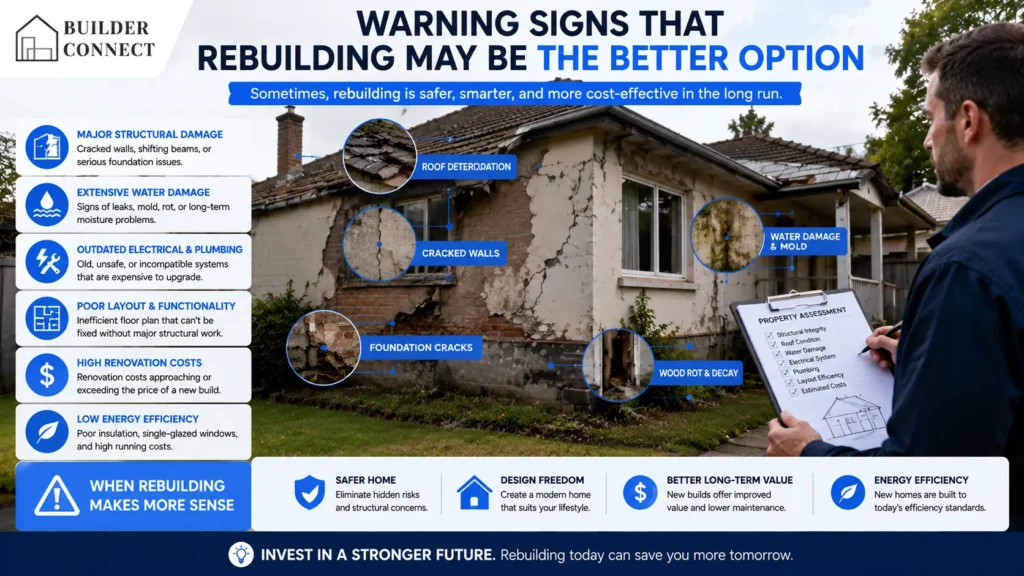
Warning Signs That Rebuilding May Be The Better Option
Renovating can be a smart way to improve an existing home, but there are times when repairs, upgrades, and layout changes become more complicated than they are worth. When a property has serious structural issues, high-renovation costs, or a floor plan that cannot support modern living needs, demolishing and rebuilding may offer better long-term value than trying to work around old problems.
Major Structural Problems
Major structural problems are one of the clearest signs that rebuilding may be the more practical choice. If the bones of the home are weak, damaged, or unsafe, renovation costs can rise quickly because builders must fix the underlying structure before any cosmetic or functional upgrades can begin.
Foundation movement is a serious concern because it can affect the entire home. Cracked walls, uneven floors, sticking doors, and visible gaps around windows may point to movement beneath the property. In some cases, foundation repairs are possible, but if the damage is widespread, the cost of stabilizing the home may take up a large part of the renovation budget before any visible improvements are made.
Severe water damage can also make renovation less cost-effective. Long-term leaks, poor drainage, roof failures, and hidden moisture can damage framing, flooring, insulation, and internal linings. Once water has spread through key areas of the home, repairs may involve stripping large sections back to the frame, replacing materials, treating mould, and upgrading waterproofing systems.
Extensive rot or deterioration is another warning sign. Timber framing, subfloors, roof structures, and wall cavities can weaken over time, especially in older homes or properties that have not been well maintained. When rot affects structural elements, the renovation becomes less about updating the home and more about rebuilding damaged parts piece by piece.
- Foundation movement: This can create safety risks and may require costly engineering work before renovation can continue.
- Severe water damage: Hidden moisture can lead to mould, decay, and repeated repair costs if the source is not fully resolved.
- Extensive rot: Widespread timber decay can make the existing structure unreliable and expensive to restore properly.
Renovation Costs Exceeding a Significant Portion of Rebuild Costs
Renovation may seem cheaper at first, but that is not always the case once hidden issues, labour, materials, permits, and structural upgrades are added. If the projected renovation cost gets close to the cost of a new build, rebuilding may provide better value because it gives you a new, code-compliant home instead of a heavily patched older one.
A proper cost-benefit analysis is essential before making the decision. This means comparing more than the initial quote. Homeowners should look at total project costs, future maintenance, energy efficiency, resale value, design limitations, and the likelihood of unexpected expenses. A low-renovation estimate can become unreliable if it does not include contingencies for hidden defects.
Diminishing returns happen when each extra dollar spent on renovation delivers less practical value. For example, if a home needs new wiring, plumbing, roofing, insulation, structural repairs, and layout changes, the project may become almost as expensive as building new. At that point, a rebuild may offer a cleaner result, better warranties, improved energy performance, and fewer long-term maintenance concerns.
Renovation costs can also increase when builders need to work around old materials, tight spaces, uneven framing, or outdated construction methods. This type of work often takes longer than new construction because it involves careful removal, repair, adjustment, and compliance upgrades.
- Cost-benefit analysis: Compare renovation costs against rebuild costs, but also include future repairs, running costs, and resale potential.
- Diminishing returns: When major spending only brings the home up to an acceptable standard, rebuilding may deliver stronger long-term value.
- Hidden expenses: Older homes often reveal extra work once walls, floors, or ceilings are opened during construction.
Layout Limitations That Cannot Be Easily Fixed
A home may be structurally sound but still difficult to renovate if the layout does not suit modern living. Inefficient floor plans, poor room placement, limited natural light, narrow hallways, and awkward connections between spaces can make the home feel outdated even after expensive upgrades.
Inefficient floor plans often create problems that cosmetic renovations cannot solve. A new kitchen or bathroom may improve the appearance of the home, but it will not fix deeper issues such as poor indoor-outdoor flow, undersized living areas, lack of storage, or bedrooms positioned in impractical locations. If the home needs major wall removals, additions, or reconfiguration, the cost and complexity can rise quickly.
Structural constraints can make layout changes even harder. Load-bearing walls, low-ceiling heights, old foundations, roofline limitations, and difficult site conditions may restrict what can be changed safely. Removing or relocating structural elements usually requires engineering input, approvals, and additional construction work, which can make renovation less straightforward.
In some cases, rebuilding gives homeowners the freedom to design a better home from the ground up. A new build can make better use of the site, improve natural light, create open-plan living, add storage, increase energy efficiency, and support future needs such as growing families, accessibility, or work-from-home spaces.
- Inefficient floor plans: Poor room placement and limited flow can make the home less functional even after major updates.
- Structural constraints: Load-bearing walls, roof limitations, and old foundations can restrict design changes and increase costs.
- Design flexibility: Rebuilding allows the home to be planned around current lifestyle needs instead of forcing changes into an unsuitable structure.
When structural problems, high-renovation costs, and difficult layout limitations all appear together, rebuilding may become the smarter investment. The best decision should be based on a detailed inspection, realistic pricing, and a clear understanding of what the finished home needs to achieve.
When Renovating Is Usually The Smarter Choice
Renovating is usually the smarter choice when the existing home already has a reliable structure, the changes needed are mostly functional or cosmetic, and local planning rules make demolition difficult or expensive. In these situations, renovation can help homeowners improve comfort, usability, and property value without taking on the full cost, time, and complexity of a complete knock-down rebuild.
The Home Has Good Structural Integrity
A renovation is often more cost-effective when the core structure of the home is still in good condition. If the house has strong foundations, sound framing, and no major structural movement, homeowners can usually build on what already works instead of paying for demolition, site clearing, new foundations, and full construction from scratch.
Strong foundations are one of the clearest signs that renovation may be the better option. A home with stable footings, minimal cracking, and no major subsidence gives builders a solid base to work from. This can make kitchen renovations, bathroom upgrades, internal layout changes, and cosmetic improvements more practical because the main structure does not need to be replaced.
Sound framing is just as important. If the wall frames, roof structure, floor system, and load-bearing elements are still reliable, the home may only need targeted improvements rather than a complete rebuild. A professional building inspection can help confirm whether the property is suitable for renovation or whether hidden issues could make the project more expensive.
- Foundation Condition: Stable foundations reduce the need for major structural repairs and help keep renovation costs more predictable.
- Wall And Roof Framing: Sound framing allows builders to update rooms, finishes, and layouts without rebuilding the entire home.
- Moisture And Rot Checks: A renovation is more sensible when the property has no widespread water damage, timber rot, or pest-related deterioration.
- Professional Inspection: A qualified builder, engineer, or building inspector can identify whether the existing structure is strong enough to support the planned upgrades.
You Only Need Functional Updates
Renovation is usually the better choice when the home still works overall but needs targeted improvements to suit modern living. Many homeowners do not need a completely new house. They may simply need a better kitchen, updated bathrooms, improved storage, fresh flooring, modern lighting, or more practical living spaces.
Kitchen renovations are a common reason to renovate rather than rebuild. A dated kitchen can make the whole home feel tired, but replacing cabinetry, benchtops, appliances, lighting, and layout features can dramatically improve daily use. If the kitchen location still makes sense, updating the space is often far cheaper than demolishing and rebuilding the entire property.
Bathroom upgrades can also deliver strong value without requiring major structural work. Replacing old fixtures, improving waterproofing, upgrading ventilation, and refreshing tiles can make the home more comfortable and appealing. These functional updates can also help reduce maintenance issues when completed properly by qualified trades.
Cosmetic improvements are another reason renovation may be the smarter option. New paint, flooring, cladding repairs, window treatments, lighting, and exterior updates can refresh the home without changing its entire structure. These changes are especially useful when the property feels outdated but is still safe, stable, and well-built.
- Kitchen Renovations: Updating the kitchen can improve layout, storage, style, and everyday convenience without the cost of a full rebuild.
- Bathroom Upgrades: Modern bathrooms can improve comfort, hygiene, ventilation, and resale appeal when the existing structure is still suitable.
- Cosmetic Improvements: Paint, flooring, lighting, and exterior finishes can give the home a fresh look while keeping costs controlled.
- Targeted Improvements: Renovating specific areas helps homeowners focus the budget where it delivers the most practical benefit.
Local Planning Restrictions Favor Renovation
In some areas, renovation is not just the cheaper option, but also the more practical one because local planning rules may restrict demolition or make rebuilding more complicated. Heritage overlays, zoning limitations, protected streetscapes, and demolition restrictions can all affect what homeowners are allowed to change.
Heritage overlays can make it difficult to demolish an older property, especially if the home has architectural, historical, or streetscape value. In these cases, renovation may allow homeowners to preserve important character features while still improving comfort, function, and energy performance. This can include restoring exterior details, updating interiors, and carefully adding modern amenities.
Zoning limitations can also influence the decision. Some properties may have restrictions on building height, site coverage, setbacks, floor area, or dwelling density. If a rebuild would trigger stricter rules or reduce what can be built on the site, renovating the existing home may protect valuable floor space and avoid unnecessary approval issues.
Demolition restrictions can add cost, delays, and uncertainty. Even when demolition is technically possible, approvals may take time and may require reports, applications, neighbour consultation, or council review. Renovation can sometimes move forward more smoothly, especially when the proposed work stays within existing building boundaries.
- Heritage Overlays: Renovation can preserve character features while allowing practical improvements that suit modern living.
- Zoning Limitations: Existing homes may have advantages that a new build would not be allowed to repeat under current rules.
- Demolition Restrictions: Approval requirements can make rebuilding slower, more expensive, and less certain than renovating.
- Planning Advice: Speaking with a planner, architect, or local council early can help homeowners understand whether renovation is the simpler path.
Choosing renovation makes the most sense when the home has a strong structure, the required upgrades are manageable, and local rules make rebuilding less practical. With the right professional advice, homeowners can improve comfort, function, and long-term value while avoiding the larger cost and disruption of starting again.

Questions To Ask Before Making A Decision
Choosing between renovating and demolishing to rebuild is not only about comparing the first quote you receive. The right choice depends on your budget, how long you plan to stay, the condition of the existing home, and the likely resale value after the work is complete. Asking the right questions early can help you avoid expensive surprises and make a more confident, well-informed decision.
What Is Your Budget?
Your budget is one of the biggest factors when deciding whether it is cheaper to renovate or demolish and rebuild. A renovation may seem more affordable at first, especially if you are keeping the existing structure, but costs can rise quickly when hidden problems are uncovered. Rebuilding usually has a higher upfront cost, but it can sometimes provide better long-term value if the existing home needs major structural repairs, full-system upgrades, or extensive layout changes.
A realistic budget should include more than materials and labour. Homeowners also need to account for design fees, council approvals, engineering reports, temporary accommodation, demolition costs, site-preparation work, and final finishing details. Without these extra costs included, it becomes much harder to compare renovation and rebuild options accurately.
- Realistic project costs: Get detailed quotes that separate labour, materials, approvals, site work, professional fees, and finishing costs so you can compare each option fairly.
- Contingency allowances: Set aside a contingency fund, often around 10 to 20 percent, because renovations can reveal hidden issues such as water damage, outdated wiring, poor drainage, or structural movement.
How Long Do You Plan To Stay In The Home?
Your future plans should play a major role in the decision. If you plan to stay in the home for many years, a rebuild may be worth considering because it gives you the chance to design a home that suits your lifestyle, family needs, energy-efficiency goals, and long-term comfort. If you only plan to stay for a short time, a targeted renovation may be more practical, especially if it improves liveability and resale appeal without overcapitalising.
Lifestyle goals also matter. A family that needs more bedrooms, better indoor-outdoor flow, improved accessibility, or a more functional layout may find that renovation has limits. In some cases, trying to force a modern lifestyle into an old floor plan can become costly and inefficient. Rebuilding can offer a clean-slate solution, while renovating may be better when the existing layout already works well.
- Lifestyle goals: Think about how the home needs to support your daily routines, future family changes, storage needs, entertaining spaces, and accessibility requirements.
- Return on investment: Compare how much value each option may add against the total project cost, especially if resale value is a major part of your decision.
What Does A Professional Assessment Reveal?
Before making a final choice, it is important to understand the true condition of the property. A home can look suitable for renovation from the outside but still have serious issues behind the walls, under the floor, or within the roof structure. A professional assessment helps identify whether the existing building is worth preserving or whether a rebuild may be the safer and more cost-effective option.
Builder inspections, structural engineering reports, and quantity surveying advice can give you a clearer picture of likely costs and risks. This is especially important for older homes, properties with visible cracking, uneven floors, moisture problems, poor drainage, or outdated electrical and plumbing systems. Professional advice also supports better decision-making because it reduces guesswork and helps you compare both options using evidence rather than assumptions.
- Builder inspections: A qualified builder can assess the condition of the home, identify practical renovation challenges, and explain whether the proposed work is realistic.
- Structural engineering reports: An engineer can investigate foundations, framing, load-bearing walls, movement, and structural risks that may affect the cost or safety of renovation.
- Quantity surveying advice: A quantity surveyor can provide detailed cost estimates, helping you compare renovation and rebuild expenses with greater accuracy.
What Are The Expected Resale Outcomes?
Even if you are improving the home for your own comfort, resale value should still be considered. A well-planned renovation can increase appeal, especially when it improves kitchens, bathrooms, outdoor areas, and everyday functionality. However, a new build may attract stronger buyer interest if the local market values modern layouts, energy-efficient features, lower maintenance, and new-home warranties.
Market demand varies by location. In some areas, buyers may value character homes and prefer thoughtful renovations that preserve original features. In other areas, buyers may pay more for a modern, low-maintenance home with open-plan living, better insulation, and updated building systems. Understanding local property trends can help you avoid spending money on improvements that do not match buyer expectations.
- Market demand: Research what buyers in your area are looking for, including home size, layout, design style, energy performance, parking, and outdoor living spaces.
- Property valuation considerations: Speak with local real estate professionals or valuers to understand whether renovation or rebuilding is likely to deliver stronger resale value in your specific market.
Taking time to answer these questions can make the renovate-or-rebuild decision much clearer. When you understand your budget, long-term plans, property condition, and resale potential, you can choose the option that offers the best balance of cost, comfort, and future value

Expert Advice For Comparing Renovation And Rebuild Costs
Comparing renovation and rebuild costs is not just about finding the cheapest upfront price. A smart decision should consider the current condition of the home, the level of work required, the long-term value of the property, and how well the finished result will support your lifestyle. Getting expert input early helps homeowners avoid budget surprises and make a more confident choice between improving the existing structure and starting again with a new build.
Obtain Multiple Professional Quotes
One of the most practical ways to compare renovation and rebuild costs is to collect quotes from different types of professionals. A single estimate rarely gives the full picture because builders, renovation specialists, and new home contractors may assess the same property from different perspectives. This makes it easier to identify realistic pricing, hidden risks, and cost-saving opportunities before making a final decision.
- Builders: A qualified builder can inspect the existing structure, identify repair needs, and estimate the cost of improving the current home. Their advice is especially useful if the property has ageing materials, layout issues, or signs of structural movement.
- Renovation Specialists: Renovation specialists understand the challenges of working with existing homes, including unexpected wall, roof, plumbing, and electrical issues. They can help determine whether the renovation scope is practical or likely to become more expensive than expected.
- New Home Contractors: New home contractors can provide a clear rebuild estimate based on demolition, site preparation, materials, labour, and construction timelines. Their quote helps homeowners compare the cost of a fresh build against the cost of major renovation work.
Conduct A Detailed Cost-Benefit Analysis
A proper cost-benefit analysis looks beyond the first quote and compares the full financial impact of each option. Renovating may appear cheaper at first, but major structural work, outdated services, and ongoing maintenance can change the overall value. Rebuilding may cost more upfront, but it can offer better energy efficiency, lower repair costs, and a home designed around current building standards.
- Total Project Cost Comparison: Compare all expected costs, including design fees, permits, demolition, site works, materials, labour, temporary accommodation, and contingency allowances. This gives a clearer view of the real investment required for both renovating and rebuilding.
- Lifetime-Ownership Costs: Consider future repair costs, energy bills, maintenance needs, insurance implications, and the expected lifespan of major materials. A lower upfront renovation cost may not always deliver the best long-term financial result if the home still needs ongoing repairs.
- Resale Value: Think about how each option may affect future market appeal. A well-planned renovation can improve value, but a modern new build may attract stronger buyer interest if it offers better layout, comfort, and energy performance.
Consider Future Needs, Not Just Current Needs
The best choice should support how the home will be used in the years ahead, not just what feels affordable today. A renovation may solve short-term problems, but it can become limiting if the home still lacks space, accessibility, or functional flow. Rebuilding gives homeowners the chance to plan for future lifestyle changes from the beginning.
- Family Growth: If the household may grow, the design should allow for extra bedrooms, larger living areas, better storage, and flexible spaces. Planning ahead can prevent the need for another major renovation later.
- Accessibility: Future-ready design may include wider doorways, step-free access, safer bathrooms, and easier movement throughout the home. These features can improve comfort for ageing homeowners, young families, or anyone with changing mobility needs.
- Long-Term Functionality: A home should work well for daily living, not just look updated. Consider natural light, storage, open-plan areas, work-from-home spaces, outdoor connection, and how each room supports practical day-to-day use.
Choosing between renovating and rebuilding becomes much easier when the decision is based on expert advice, accurate pricing, and long-term value rather than guesswork. By comparing professional quotes, reviewing lifetime costs, and planning around future needs, homeowners can choose the option that delivers better comfort, stronger property value, and fewer costly surprises.
Before deciding whether to renovate or rebuild, take the next step by getting expert advice based on your actual property, budget, and long-term goals. A professional assessment can reveal hidden costs, structural concerns, design opportunities, and the most practical path forward, helping you avoid expensive mistakes and choose the option that delivers the best value for your home.
References
- Real Cost Comparison Most Homeowners Overlook
https://www.3dhomeimprovements.com/blogs/renovate-vs-rebuild-house-cost - Is It Cheaper to Tear Down a House and Rebuild?
https://engineerfix.com/is-it-cheaper-to-tear-down-a-house-and-rebuild/ - Demolition vs. Renovation: When to Tear Down or Fix Up
https://www.acesfour.com/blog/demolition-vs-renovation - Should I Demolish and Rebuild or Renovate My House?
https://www.hometowndemolitioncontractors.com/blog/should-i-demolish-and-rebuild-or-renovate-my-house - Rebuild vs. Renovate | When Is Demolishing a House the Right Choice?
https://parkplacefinance.com/renovate-or-rebuild/

FAQs: About Is It Cheaper to Renovate Or Demolish And Rebuild
Conclusion
Deciding whether renovating or rebuilding is the better investment comes down to the true condition of the property, the scale of work required, your available budget, and your long-term goals. Renovating is often the more cost-effective choice when the existing home has sound foundations, a practical layout, and only needs cosmetic upgrades, functional improvements, or selected structural changes. However, demolishing and rebuilding may provide better long-term value if the home has major structural issues, outdated plumbing or electrical systems, poor energy efficiency, or a layout that would be expensive to fix through renovation alone. The cheapest option is not always the one with the lowest upfront cost, because hidden repair work, temporary accommodation, council approvals, material costs, and future maintenance can all affect the final investment. Before committing to either path, homeowners should get a professional assessment, compare detailed quotes, and speak with an experienced builder, architect, or renovation specialist who can evaluate the property properly and recommend the most cost-effective solution for their circumstances.
Find A Professional Renovator’s Company Near You!
- Home Renovations Kapiti
- Home Renovations Clyde
- Home Renovations Central Otago
- Home Renovations Queenstown
- Home Renovations Wanaka
- Home Renovations Cromwell
- Home Renovations Alexandra
- Home Renovations Hamilton
- Renovations Christchurch

About the Author:
Mike Veail is a recognized digital marketing expert with over 6 years of experience in helping tradespeople and small businesses thrive online. A former quantity surveyor, Mike combines deep industry knowledge with hands-on expertise in SEO and Google Ads. His marketing strategies are tailored to the specific needs of the trades sector, helping businesses increase visibility and generate more leads through proven, ethical methods.
Mike has successfully partnered with numerous companies, establishing a track record of delivering measurable results. His work has been featured across various platforms that showcase his expertise in lead generation and online marketing for the trades sector.
Learn more about Mike's experience and services at https://theleadguy.online or follow him on social media: