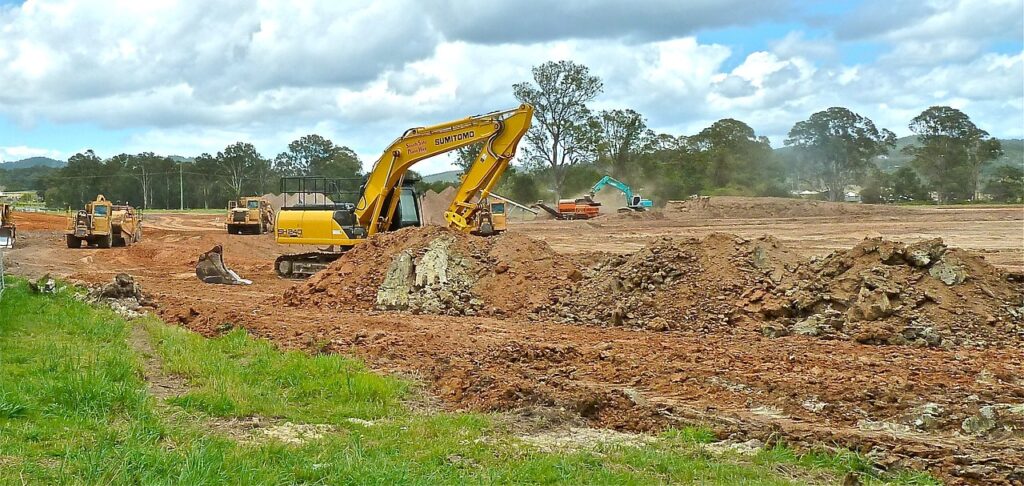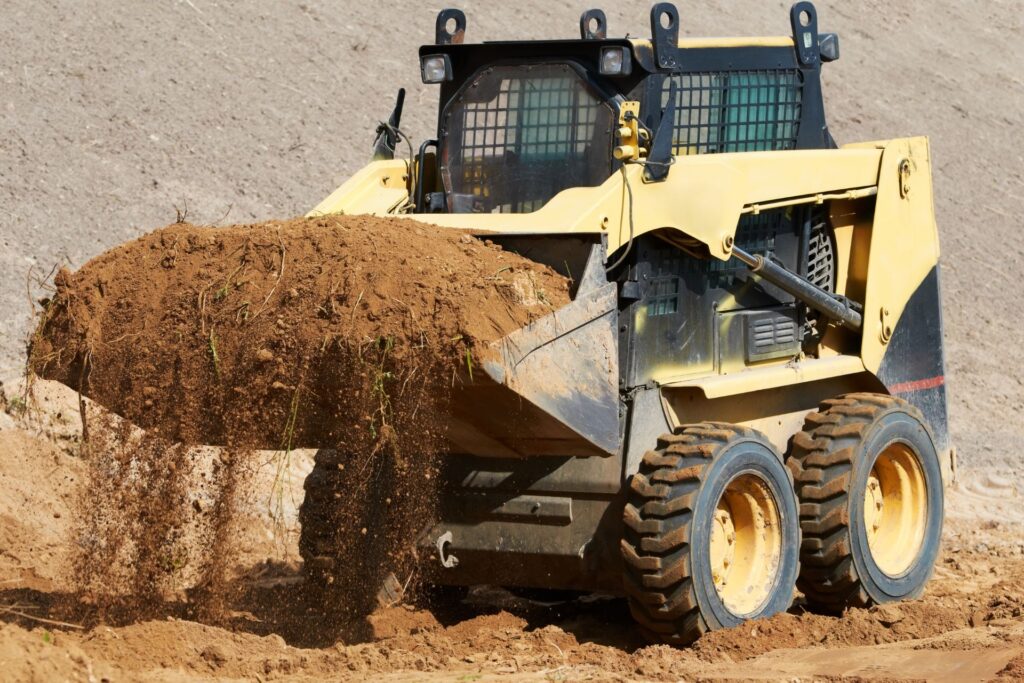
Welcome to our complete guide to earthworks pricing Auckland, where you will learn what excavation work typically costs, how contractors calculate their rates, and which site conditions can increase your final budget. Whether you are preparing land for a new home, driveway, retaining wall, drainage system, pool, or landscaping project, understanding the main cost factors can help you avoid unexpected expenses and compare quotes with confidence. This guide explains common pricing methods, soil removal costs, machinery rates, consent considerations, hidden charges, and practical ways to prepare for an accurate earthworks estimate.
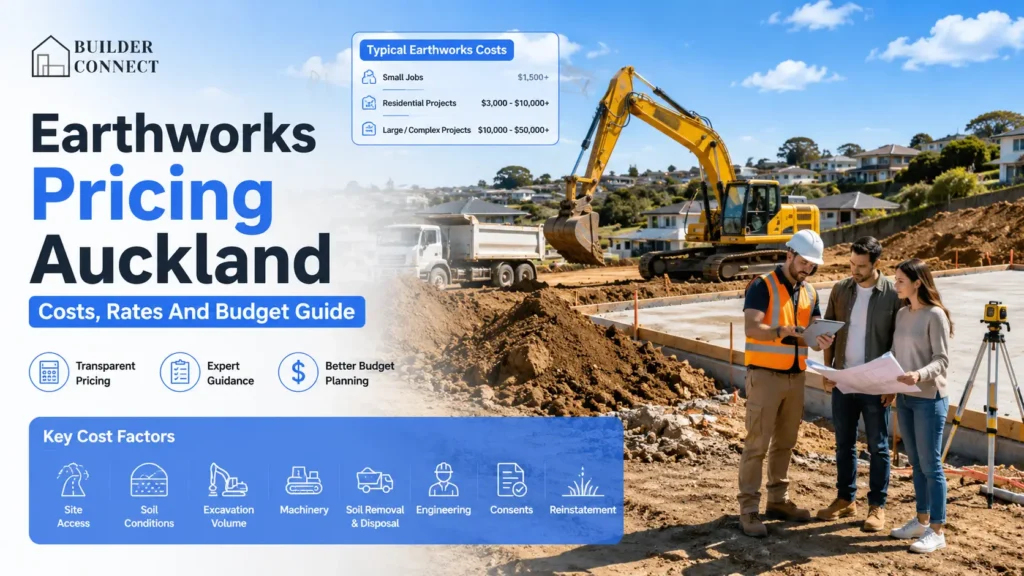
Earthworks pricing in Auckland commonly ranges from $1,500 for small residential jobs to $50,000 or more for large or complex projects. Costs depend on excavation volume, soil type, site access, machinery, disposal fees, engineering, drainage, consent requirements, and the amount of reinstatement needed after the work.
- How Much Do Earthworks Cost In Auckland?
- What Affects Earthworks Pricing In Auckland?
- Common Earthworks Projects And Their Pricing Factors
- What Is Usually Included In An Earthworks Quote?
- Are Earthworks Consents Required In Auckland?
- Hidden And Additional Earthworks Costs
- How To Estimate An Earthworks Budget
- How To Get An Accurate Earthworks Quote
- How To Compare Earthworks Contractors In Auckland
- How To Reduce Earthworks Costs Without Cutting Corners
- Common Earthworks Pricing Mistakes To Avoid
- References
- FAQs: About Earthworks Pricing Auckland
- Conclusion
- Find A Professional Earthworks Company Near You!
How Much Do Earthworks Cost In Auckland?
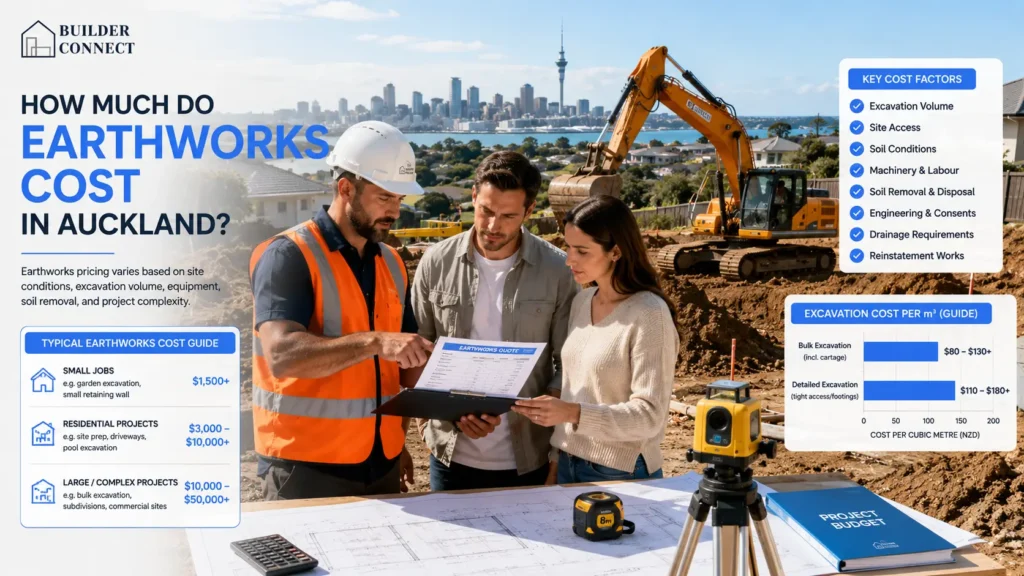
Earthworks pricing in Auckland commonly ranges from around $1,500 for small residential jobs to more than $50,000 for large or complex projects. The final cost depends on factors such as excavation volume, site access, soil conditions, machinery requirements, drainage, engineering, spoil disposal, and any consent requirements. Contractors may calculate pricing using a cost per cubic metre, an hourly or daily equipment rate, a truckload rate for soil removal, or a fixed price for the entire project. While published industry pricing can provide a useful starting point for budgeting, every property is different, so an on-site assessment is the best way to receive an accurate quotation.
Typical Earthworks Price Ranges
The type of excavation work has a significant influence on pricing because every project requires different machinery, labour, time, and disposal requirements. A small garden excavation completed in a few hours is naturally very different from preparing an entire building platform for a new home.
| Project Type | Possible Starting Range* | Main Cost Drivers | Common Exclusions | Site Inspection Recommended |
| Small garden excavation | From $1,500 | Excavation size, access, soil type | Landscaping, reinstatement | Yes |
| Residential site clearing | From $2,000 | Vegetation removal, machinery, waste disposal | Tree removal, demolition | Yes |
| Driveway excavation | From $2,500 | Excavation depth, drainage, spoil removal | New driveway construction | Yes |
| Foundation excavation | From $3,000 | Footing dimensions, engineering requirements | Concrete work | Yes |
| Retaining-wall excavation | From $2,500 | Trenching, slope, drainage, access | Wall construction | Yes |
| Swimming-pool excavation | From $5,000 | Pool size, depth, soil conditions | Pool installation | Yes |
| Trenching and drainage | From $1,500 | Trench length, depth, underground services | Drainage materials | Yes |
| Site levelling | From $2,000 | Cut-and-fill requirements, machinery | Topsoil replacement | Yes |
| Bulk excavation | From $10,000 | Excavation volume, truck movements, disposal | Engineering, testing | Yes |
| Soil removal and disposal | From several hundred dollars per load | Volume, haulage distance, disposal facility | Excavation work | Sometimes |
These figures are broad budgeting estimates only. Actual pricing varies depending on site conditions, project scope, and contractor quotations.
A professional site inspection allows the contractor to evaluate factors that cannot be accurately determined from plans or photographs alone. Items such as restricted access, steep terrain, underground services, unstable ground, or difficult soil conditions often become the largest contributors to the overall project cost.
Earthworks Pricing Per Cubic Metre
Many residential and commercial earthworks projects are priced according to the amount of material being excavated. This method works particularly well when the excavation volume can be measured with reasonable accuracy before work begins.
A cubic metre represents a space measuring one metre long, one metre wide, and one metre deep. Contractors estimate this volume using site measurements, architectural drawings, engineering plans, topographical surveys, or machine-generated digital models. Multiplying the excavation length, width, and average depth provides an estimated volume, although irregular shapes and sloping ground often require more detailed calculations.
Published Auckland pricing guides commonly place bulk excavation and cartage at approximately $80 to $130 per cubic metre, while detailed excavation involving greater precision may range from around $110 to $180 per cubic metre. These figures should only be treated as general market estimates because every site has different conditions.
It is also important to understand that excavated soil expands once it is removed from the ground. This process, often referred to as bulking, means that one cubic metre of compacted soil can occupy a noticeably larger volume after excavation. As a result, spoil disposal may require additional truckloads, increasing transport and tipping costs.
The excavation cost per cubic metre may also change when unexpected materials are encountered. Rock excavation generally requires specialised attachments and progresses more slowly than standard excavation. Wet clay can reduce productivity and make machinery movement more difficult. Contaminated soil may require testing, specialised handling, and disposal at approved facilities. Mixed fill containing construction debris, concrete, timber, or rubbish can also increase sorting and disposal costs.
Projects involving significant cut-and-fill pricing calculations require careful planning to determine whether excavated material can be reused on-site or whether spoil disposal will be necessary. Reusing suitable material can reduce soil removal cost, although this depends on engineering requirements, final site levels, and soil quality.
Hourly And Daily Excavator Rates
Hourly or daily pricing is commonly used when the total excavation volume cannot be accurately predicted before work begins. This pricing method is often suitable for smaller residential projects, exploratory excavation, demolition preparation, emergency work, or projects where the scope may change during construction.
Several factors influence hourly excavation rates.
- Excavator size: Larger machines generally have higher operating costs but can complete high-volume excavation much faster than smaller equipment.
- Experienced operator: Skilled operators often work more efficiently, minimise unnecessary excavation, and reduce the likelihood of costly mistakes.
- Fuel consumption: Fuel usage increases with machine size, operating hours, and the difficulty of the excavation.
- Mobilisation: Transporting machinery to and from the site is commonly charged separately, particularly for larger excavators.
- Minimum booking periods: Many contractors have minimum hourly or half-day charges regardless of the actual working time.
- Truck hire: Additional trucks may be required when excavated soil needs to be removed continuously from the site.
- Attachments: Rock breakers, augers, grabs, compactors, and specialised buckets may attract additional hire charges.
- Site supervision: Larger or more complex projects may require supervision to coordinate machinery, deliveries, and safety requirements.
- Project delays: Weather, utility strikes, inspection delays, or restricted site access may extend project duration beyond the original estimate.
Published New Zealand guides commonly indicate digger-and-operator hire between approximately $90 and $150 per hour, depending on machine size, project complexity, and regional conditions. These figures should be viewed as general industry guidance rather than guaranteed Auckland pricing because actual rates vary between contractors and project types.
Although hourly pricing may appear less predictable than a fixed quotation, it can be a fair approach when ground conditions are uncertain or the amount of work cannot be accurately measured before excavation begins.
Fixed-Price Quotes Versus Charge-Up Work
Contractors use several pricing methods depending on how well the project scope is defined. Understanding the differences helps homeowners compare quotations more confidently and avoid unexpected costs later.
A fixed-price quote provides a single agreed amount for completing the specified work. This option is often preferred when engineering plans, excavation volumes, and project requirements are well defined. It provides greater budget certainty because the contractor accepts much of the pricing risk, provided the scope does not change.
Estimated budgets provide an approximate cost based on the available information before a detailed site assessment or final design is completed. They are useful during the planning stage but should not be treated as guaranteed pricing.
Hourly charge-up work is commonly used when excavation conditions cannot be accurately predicted. Rather than estimating unknown risks, the contractor charges for the actual time, labour, machinery, and materials required to complete the work.
Provisional sums are allowances included within a fixed-price quotation for work that cannot be accurately priced before construction begins. For example, if the amount of rock beneath the surface is unknown, the contractor may include a provisional allowance that is adjusted once actual conditions become clear.
Cost-plus arrangements involve charging the actual project costs plus an agreed management fee or percentage. This pricing method is more common on larger or evolving projects where the final scope may change during construction.
Before accepting any earthworks quotation, homeowners should ask several important questions to ensure they understand exactly what has been included.
- Assumptions: What site conditions and excavation volumes has the contractor based the price on?
- Soil disposal: Does the quote include loading, transport, tipping fees, and spoil disposal?
- Unexpected rock: How will additional excavation be priced if rock or hard material is encountered?
- Weather delays: Are rain delays or weather-related interruptions chargeable?
- GST: Does the quoted price include Goods and Services Tax?
- Professional fees: Are council fees, engineering costs, geotechnical reports, inspections, and testing included or charged separately?
Understanding these details before work begins makes it much easier to compare quotations on an equal basis and reduces the likelihood of unexpected variations during construction.
Knowing how contractors calculate earthworks pricing gives you a stronger foundation for budgeting and comparing quotations. Looking beyond the headline price and understanding exactly what is included will help you make a more informed decision and reduce the risk of costly surprises once excavation is underway.
What Affects Earthworks Pricing In Auckland?
Earthworks pricing in Auckland is influenced by much more than the hourly rate of an excavator. While it may be tempting to compare contractors based on machinery rates alone, the lowest hourly price does not always result in the lowest overall project cost. Every site has unique conditions that affect the amount of labour, equipment, planning, and time required to complete the work safely and efficiently. Understanding these factors will help you compare quotes more accurately and set realistic expectations before your project begins.
Site Access And Working Space
Easy site access allows machinery and trucks to work efficiently, reducing labour time and improving productivity. When access is restricted, contractors often need to adjust their equipment and working methods, which can increase the total project cost.
Common access challenges include:
- Narrow driveways: Tight entrances may prevent larger excavators and trucks from reaching the work area.
- Limited side access: Many residential properties only have narrow pathways beside the house, requiring smaller machines that move less material with each pass.
- Overhead power lines: Overhead services can limit the size of machinery that can safely operate on-site.
- Existing buildings: Homes, garages, sheds, and other structures often reduce available working space and require more careful excavation.
- Fences and landscaping: Existing fences, gardens, retaining walls, and outdoor features may need protection throughout the project.
- Neighbouring properties: Work close to boundaries may require extra care to avoid damage or disruption.
- Traffic management: Busy roads may require traffic-control measures for truck movements and machinery delivery.
- Machine delivery: Transporting larger equipment into difficult locations can add mobilisation costs.
- Restricted truck access: Limited space for trucks to enter, turn, or park may slow the removal of excavated material.
Restricted access often increases costs because contractors may need to use alternative methods to complete the same amount of work.
These methods can include:
- Smaller machinery: Compact excavators fit into tight spaces but usually excavate more slowly than larger machines.
- More labour: Workers may need to move soil manually where machinery cannot reach.
- Extra handling: Material may need to be moved multiple times before it reaches a truck.
- Conveyor systems: Conveyors can transport soil through confined areas where trucks cannot access.
- Cranes: Some projects require cranes to lift machinery or materials into difficult locations.
- Additional truck movements: Smaller loads may require more trips to remove the same volume of soil.
Soil Type And Ground Conditions
The condition of the ground has one of the greatest influences on excavation costs. Two sites with similar dimensions can require very different amounts of time and equipment simply because the soil behaves differently.
Some of the most common ground conditions include:
- Clay: Dense clay can become extremely hard during dry weather and very difficult to work in after heavy rain.
- Loose fill: Previously placed fill may be unstable and require removal or replacement before construction begins.
- Volcanic rock: Parts of Auckland contain volcanic rock that often requires specialised equipment such as rock breakers.
- Soft ground: Weak soils may require stabilisation before construction can continue.
- Saturated soil: Waterlogged ground slows excavation, increases safety risks, and makes transport more difficult.
- High groundwater: Groundwater entering the excavation may require pumping and temporary drainage measures.
- Buried construction waste: Old concrete, bricks, timber, and other buried materials can delay excavation and increase disposal costs.
- Unstable slopes: Sloping sites may require additional engineering and temporary support during excavation.
- Contaminated material: Soil containing hazardous substances requires specialist handling, testing, and disposal procedures.
Many underground conditions cannot be confirmed by visual inspection alone. Unless geotechnical investigations have been completed before work begins, contractors may only discover hidden rock, unstable ground, buried debris, or groundwater during excavation. This uncertainty is one reason why some quotations include provisional allowances or variation clauses.
Site Slope And Excavation Depth
Steep or deep excavations usually require more planning than work on level ground. They also introduce additional safety and engineering requirements that can affect both the project schedule and overall budget.
Depending on the site, contractors may need to carry out:
- Staged excavation: Removing soil in planned stages helps maintain stability throughout the project.
- Benching: Creating stepped excavation faces reduces the risk of soil collapse.
- Temporary retaining: Temporary retaining systems may support nearby structures or boundaries while excavation is underway.
- Shoring: Timber, steel, or engineered shoring systems help stabilise deep excavations.
- Slope stabilisation: Additional measures may be needed to reduce movement on steep sites.
- Specialised machinery: Certain slopes require machinery designed to operate safely on uneven ground.
- Engineering supervision: Engineers may inspect excavation stages to confirm compliance with design requirements.
- Additional safety controls: Deep excavations often require barriers, exclusion zones, and other site-safety measures.
These additional requirements increase both labour and equipment costs but are essential for maintaining a safe work environment and protecting nearby structures.
Volume Of Soil Being Excavated
The amount of soil being removed directly affects the size of the project and the resources required to complete it. Larger excavation volumes generally involve more machinery, more truck movements, and longer project durations.
Project size influences several areas of the quotation, including:
- Machine selection: Larger excavators may become more economical on high-volume projects.
- Truck numbers: More material requires additional truck movements for removal or transport.
- Disposal volume: Greater excavation volumes usually increase tipping and disposal costs.
- Project duration: Larger jobs naturally require more working days.
- Operator hours: Additional machine time increases labour costs.
- Survey requirements: Large developments may require more detailed surveying throughout construction.
- Cut-and-fill planning: Contractors often balance excavation and imported fill to reduce unnecessary soil removal.
Although larger projects may benefit from lower rates per cubic metre because equipment operates more efficiently, the total project cost is still significantly higher because much more work is being completed.
Soil Removal, Cartage And Tipping Fees
Many homeowners focus on excavation itself and overlook the cost of removing unwanted soil. In reality, transporting and disposing of excavated material can represent a significant portion of the final project cost, particularly when the soil cannot remain on the property.
Several factors influence these costs:
- Truck loading: Loading time depends on machinery size and site access.
- Haulage distance: Longer travel distances increase fuel, labour, and transport costs.
- Disposal-site charges: Different disposal facilities charge different rates depending on the material received.
- Clean-fill classification: Clean natural soil is generally less expensive to dispose of than mixed waste.
- Contaminated-soil fees: Contaminated material requires specialist disposal and is considerably more expensive.
- Waiting time: Delays at disposal facilities or on-site loading can increase labour charges.
- Road access: Difficult roads may reduce truck efficiency and increase transport time.
- Truck size: Larger trucks move more material per trip but require sufficient access.
- Weight restrictions: Some roads limit truck weights, increasing the number of trips required.
Where suitable and permitted by the project design, reusing excavated material on-site may reduce disposal costs. This depends on the quality of the soil, engineering requirements, available space, and final site levels.
Machinery And Equipment Requirements
Every excavation project requires equipment suited to the site’s conditions. Choosing machinery is not simply about selecting the smallest or cheapest excavator. Contractors aim to balance productivity, safety, and operating costs to complete the work efficiently.
Equipment commonly used on earthworks projects includes:
- Mini excavators: Suitable for confined residential sites with limited access.
- Medium excavators: Often used for general residential excavation and site preparation.
- Large excavators: Best suited to bulk excavation and commercial-scale projects.
- Bulldozers: Used for pushing, grading, and shaping large volumes of soil.
- Loaders: Efficient for moving stockpiled material around the site.
- Compactors: Essential for preparing stable ground before construction.
- Dump trucks: Transport excavated material across larger sites.
- Tipper trucks: Commonly used to remove spoil from residential projects.
- Rock breakers: Required when hard rock cannot be excavated using standard buckets.
- Augers: Used to drill accurate holes for retaining-wall posts, piles, and foundations.
- Trenching attachments: Improve productivity when excavating narrow service trenches.
A smaller excavator may have a lower hourly rate, but if it takes twice as long to complete the work, the overall project cost can be higher than using a larger machine. Experienced contractors choose equipment based on the most efficient solution for the site rather than the lowest hourly operating cost.
Labour And Project Duration
Earthworks involve more than operating an excavator. Many projects require a team of skilled professionals working together to complete the work safely and according to project requirements.
Labour costs may include:
- Machine operators: Operate excavation equipment safely and efficiently.
- Truck drivers: Transport excavated material and imported fill.
- Labourers: Assist with manual excavation, site preparation, and clean-up.
- Drainlayers: Install drainage systems and underground services where required.
- Surveyors: Confirm excavation levels, boundaries, and project accuracy.
- Engineers: Provide technical oversight for complex excavation and structural requirements.
- Traffic controllers: Manage vehicle movements where work affects public roads.
- Site supervisors: Coordinate daily activities, safety, scheduling, and quality control.
Project duration also has a direct impact on labour costs. Delays caused by heavy rainfall, machinery breakdowns, restricted access, unforeseen underground conditions, design changes, or waiting for inspections can extend the schedule and increase the overall cost. Good planning, accurate documentation, and clear communication between everyone involved help minimise unnecessary delays and keep the project moving efficiently.
Understanding the factors that influence earthworks pricing allows you to compare quotations on more than price alone. A detailed quote that reflects the true conditions of your site is often far more valuable than a lower estimate that overlooks important costs, helping you make a better-informed decision before excavation begins.

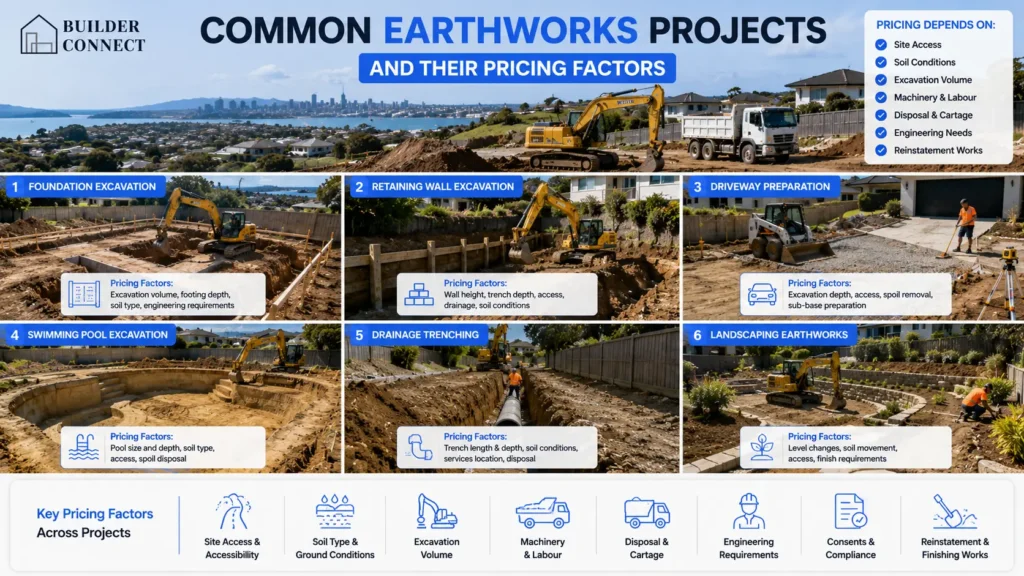
Common Earthworks Projects And Their Pricing Factors
Earthworks projects can vary greatly depending on what is being built, the site conditions, and the level of excavation required. While every project involves moving soil or preparing land, the scope of work changes significantly between building a house, installing a driveway, excavating for a swimming pool, or improving a garden. Understanding the work involved in each type of project makes it easier to compare quotes, identify potential extra costs, and set a realistic budget before construction begins.
New-Build Site Preparation
Preparing a site for a new home is one of the largest stages of residential earthworks. The goal is to create a stable, well-drained building platform that meets the requirements of the architectural and engineering plans before construction begins.
A typical new-build site may require several stages of excavation and ground preparation before the foundations can be installed. Even sites that appear relatively flat often need adjustments to achieve the required building levels and drainage.
Common work includes:
- Vegetation removal: Trees, shrubs, roots, and unwanted vegetation are cleared to create a clean construction area.
- Demolition debris removal: Old concrete, paving, sheds, fencing, and other unwanted materials are removed before excavation starts.
- Topsoil stripping: Organic topsoil is removed because it is unsuitable for supporting foundations. It may be stockpiled for landscaping later in the project.
- House-platform excavation: Soil is excavated or filled to create the correct platform level shown on the building plans.
- Cut and fill: Material is excavated from higher areas and reused to build up lower sections where suitable.
- Compaction: Fill material is compacted in layers to improve ground stability and reduce future settlement.
- Foundation preparation: The finished platform is trimmed to the required levels before foundation work begins.
- Drainage installation: Surface water and subsoil drainage may be installed before or during site preparation.
- Vehicle access: Temporary construction access is often created to allow trucks, excavators, and other equipment to enter the site safely.
Professional site preparation should always follow approved architectural and engineering drawings rather than rough estimates. These documents establish finished floor levels, drainage requirements, excavation depths, and structural design criteria. Relying on guesswork can result in unnecessary excavation, poor drainage, additional fill requirements, or expensive rework later in the build.
Foundation And Footing Excavation
Foundation excavation requires far greater precision than bulk earthmoving. Excavation must match the dimensions shown on the engineering drawings because even small errors can affect structural performance and delay construction.
The final cost depends on several factors, including the complexity of the foundation design and the ground conditions.
Important pricing factors include:
- Trench depth: Deeper excavations generally require more labour, additional spoil removal, and increased safety measures.
- Footing width: Wider footings require more excavation and often increase concrete quantities.
- Detailed excavation: Excavation around corners, steps, pile locations, or varying foundation levels takes more time than straight trenches.
- Soil stability: Soft or unstable ground may require additional excavation or engineered solutions before foundations can proceed.
- Working around services: Existing water, sewer, stormwater, gas, electrical, and communication services must be identified and protected.
- Accuracy requirements: Excavation must closely follow the engineering plans to avoid delays during inspections.
- Concrete preparation: Excavated areas often require trimming, cleaning, and preparation before reinforcing steel and concrete are installed.
- Inspection timing: Foundation excavations may need approval from engineers or building inspectors before concrete can be poured.
Careful planning at this stage reduces the risk of costly corrections and helps keep the building programme on schedule.
Driveway Excavation
Driveway excavation involves more than simply removing soil. A well-prepared base is essential for supporting vehicles and preventing future movement, cracking, or drainage problems.
The amount of excavation depends on the existing surface, proposed driveway material, ground conditions, and expected traffic loads.
Typical work may include:
- Removal of existing concrete or asphalt: Old driveway surfaces are broken up, loaded, and removed from the site.
- Excavation depth: The excavation must allow enough space for the required sub-base, basecourse, and finished surface.
- Sub-base preparation: Unsuitable soil is removed before importing compactable base materials where required.
- Drainage: Surface water should be directed away from buildings and neighbouring properties.
- Compaction: Each layer is compacted to provide a stable foundation for the finished driveway.
- Spoil disposal: Excavated soil and demolished materials may require transport to approved disposal sites.
- Access during construction: Temporary access for residents, contractors, and emergency services may need to be maintained throughout the project.
Cutting corners during driveway preparation often leads to settlement, cracking, and water pooling that can be expensive to repair later.
Retaining-Wall Excavation
Excavation for retaining walls is generally more detailed than standard earthmoving because the work supports structural construction and drainage systems.
The final cost depends on the wall design, access conditions, excavation depth, and the amount of material that must be removed or retained.
Typical excavation work may include:
- Post holes: Deep excavations for timber or steel retaining-wall posts.
- Foundation excavation: Trenches or footing excavations for concrete retaining-wall systems.
- Benching: Creating stepped excavation on sloping sites to improve stability during construction.
- Drainage trenches: Installing drainage pipes and drainage aggregate behind the retaining wall.
- Backfill: Suitable drainage material is placed behind the completed wall before compaction.
- Spoil removal: Excavated material that cannot remain on-site is loaded and transported away.
- Restricted access: Limited working space may require smaller machinery or additional manual labour.
- Engineering requirements: Larger or more heavily loaded retaining walls may require engineering input and additional excavation accuracy.
Although excavation forms an important part of retaining-wall construction, the total project cost also depends on wall materials, structural design, drainage systems, and installation methods.
Pool Excavation
Swimming pool excavation often appears straightforward, but every site presents different challenges that can affect both pricing and construction time.
Excavation requirements vary depending on the pool dimensions, access to the property, and ground conditions.
Several factors influence costs:
- Pool size and depth: Larger and deeper pools require more excavation, additional machinery time, and greater spoil removal.
- Soil volume: More excavation creates more material that must be managed or removed.
- Rock excavation: Volcanic rock or hard ground can slow production and require specialised equipment.
- Site access: Narrow access may prevent larger excavators from reaching the work area.
- Crane requirements: Some prefabricated pools require cranes for installation after excavation has been completed.
- Groundwater: Water entering the excavation may require temporary pumping or additional drainage.
- Removal of excavated material: Disposal costs increase when large volumes of soil cannot remain on the property.
- Reinstatement around the pool area: Surrounding lawns, gardens, paving, or fences may require repair once construction is complete.
Discussing access limitations and soil conditions during the quoting stage helps reduce unexpected costs later in the project.
Landscaping And Garden Earthworks
Not all earthworks involve major excavation. Smaller landscaping projects often require careful reshaping of the land to improve drainage, usability, and the appearance of outdoor spaces.
Although these jobs usually involve smaller machines, careful planning remains important to avoid unnecessary disruption.
Typical landscaping earthworks include:
- Lawn levelling: Correcting uneven areas before laying new turf or seed.
- Garden reshaping: Creating planting areas, raised beds, or improved outdoor spaces.
- Minor site cuts: Small excavations to achieve better ground levels.
- Drainage improvements: Installing drains to reduce surface water and improve soil conditions.
- Garden-wall preparation: Excavating for small decorative or functional garden walls.
- Topsoil movement: Redistributing or importing topsoil to support healthy planting.
- Small-machine access: Mini excavators are often used where access is limited or existing landscaping must be protected.
Well-planned landscaping earthworks can improve drainage, reduce erosion, and create outdoor spaces that are easier to maintain.
Trenching And Drainage Work
Trenching forms an essential part of many residential and commercial earthworks projects. Accurate trench excavation supports the installation of stormwater, wastewater, water supply, electrical, telecommunications, and drainage infrastructure.
Pricing depends on more than trench length alone.
Key factors include:
- Trench length: Longer trenches increase excavation time and material quantities.
- Trench depth: Deeper trenches often require additional safety measures and more spoil removal.
- Service locations: Existing underground services must be identified to reduce the risk of damage.
- Soil conditions: Rock, clay, unstable ground, or groundwater can slow excavation and increase costs.
- Bedding material: Pipes often require suitable bedding material before installation.
- Backfilling: Trenches are refilled using approved materials after services are installed.
- Compaction: Proper compaction helps reduce settlement after construction.
- Reinstatement: Lawns, footpaths, driveways, gardens, or paved areas may need restoration after the work is complete.
Good trenching practices reduce the likelihood of future settlement, drainage failures, and costly repairs while helping the completed installation perform as intended.
Choosing the right earthworks contractor involves more than comparing prices. Understanding the scope of each project, the factors that influence costs, and the work included in a quotation allows you to make informed decisions, prepare a realistic budget, and reduce the risk of unexpected expenses as construction progresses.
What Is Usually Included In An Earthworks Quote?
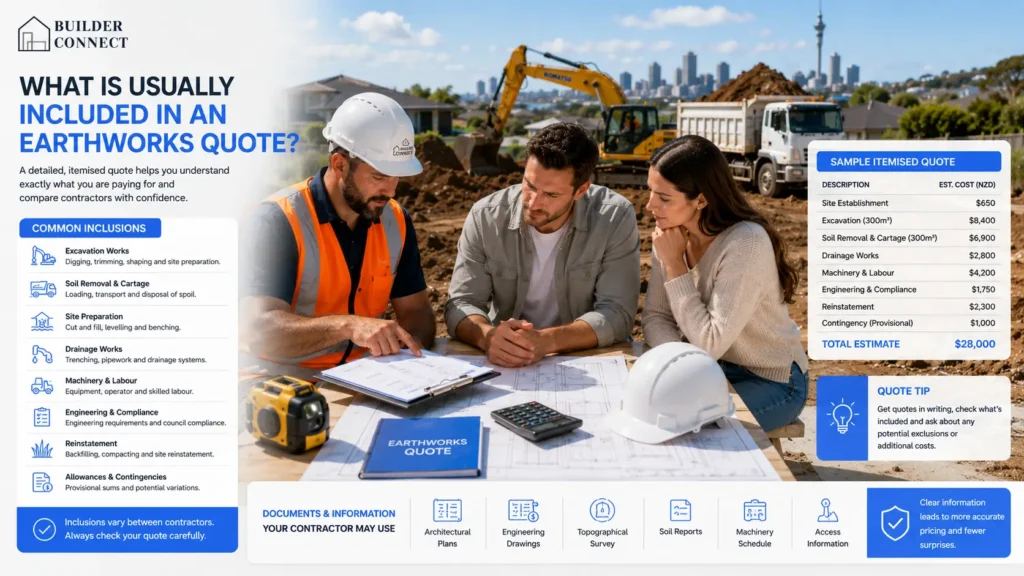
At first glance, two earthworks quotes may appear almost identical because they show similar prices or describe the same type of work. In reality, they can cover very different scopes, which makes comparing them based on price alone misleading. One contractor may include excavation, soil removal, and machine transport, while another may charge separately for those items. Understanding exactly what is included and excluded helps you compare quotes fairly, avoid unexpected costs, and choose the contractor that offers the best overall value rather than simply the lowest price.
Common Inclusions
Most residential earthworks quotes include the core services needed to complete the agreed excavation work. The exact scope varies between contractors and projects, so it is always worth requesting an itemised quotation that clearly identifies what is covered.
Typical inclusions may include:
- Excavator and operator: The use of the agreed excavator together with a qualified operator for the duration of the work.
- Standard attachments: Common attachments such as general-purpose buckets that are suitable for routine excavation tasks. Specialist attachments may attract additional charges.
- Fuel: Fuel required to operate the machinery during normal working conditions is often included within the quoted price.
- Loading: Loading excavated soil or spoil into trucks for transport or relocation around the site.
- Basic labour: Additional workers required for general site assistance, hand digging, measuring, or supporting the excavation process where appropriate.
- Site clearing: Removal of small vegetation, loose debris, or surface materials necessary to prepare the work area before excavation begins.
- Excavation: Digging, trenching, cutting, or removing soil according to the agreed plans and project scope.
- Grading: Shaping and levelling the excavated area to achieve the required finished levels where included in the contract.
- Agreed soil removal: Removal and disposal of the volume of excavated material specified in the quotation. Some contractors include only a limited volume, while others include complete removal.
- Machine transport: Delivery of the excavator and other equipment to the site and collection after the work has been completed.
- Basic site clean-up: Tidying the immediate work area by removing loose spoil and construction debris created during the excavation process.
Although these items are commonly included, every contractor prepares quotations differently. Reading the scope carefully helps ensure you understand exactly what work will be completed for the quoted price.
Common Exclusions
Some costs are frequently excluded from standard earthworks quotations because they depend on site conditions, council requirements, or circumstances that cannot be confirmed before excavation begins. Knowing these exclusions allows you to budget more accurately and ask informed questions before signing a contract.
Potential exclusions include:
- GST: Some quotations exclude Goods and Services Tax, while others include it. Always confirm whether the quoted price is inclusive or exclusive of GST.
- Tipping fees: Disposal charges at approved clean-fill or landfill facilities may be billed separately if they cannot be estimated accurately before work begins.
- Contaminated-soil disposal: Soil identified as contaminated often requires specialist handling, testing, transport, and disposal, resulting in significantly higher costs.
- Rock breaking: Excavating solid rock usually requires specialised equipment such as hydraulic breakers, increasing both labour time and machinery costs.
- Dewatering: Removing groundwater from excavations may require pumps, temporary drainage systems, or additional site management.
- Traffic management: Projects located beside public roads or busy accessways may require approved traffic-management measures that are priced separately.
- Permits and consents: Resource consents, building consents, and other approvals are generally arranged and paid for separately unless specifically included.
- Surveying: Site surveys, set-out work, or boundary confirmation are commonly completed by a licensed surveyor outside the excavation contract.
- Geotechnical reports: Soil investigations and engineering assessments are usually commissioned before construction and are often excluded from earthworks pricing.
- Engineering: Structural or civil engineering design, inspections, and certifications are typically separate professional services.
- Service relocation: Moving underground utilities such as water, sewer, gas, electrical, or telecommunications infrastructure is usually excluded.
- Imported fill: Purchasing, delivering, and compacting additional fill material is commonly priced separately unless stated otherwise.
- Compaction testing: Laboratory or field testing to verify soil compaction may be required for some projects but is not always included.
- Retaining structures: Construction of retaining walls, shoring systems, or temporary support structures is generally quoted as a separate scope of work.
- Final landscaping: Reinstating lawns, gardens, paving, planting, or decorative finishes usually falls outside the standard earthworks contract.
If a quotation does not clearly state whether these items are included, ask the contractor for clarification before work begins. A detailed discussion early in the process is often far less expensive than resolving misunderstandings after construction has started.
Provisional And Uncertain Costs
Earthworks often involve conditions that cannot be fully assessed until excavation is underway. Underground rock, buried debris, soft ground, groundwater, or inaccurate service information can all affect the final cost. Rather than guessing these unknowns, many contractors include provisional allowances that allow the project to proceed while keeping the pricing transparent.
Common methods used to manage uncertain costs include:
- Provisional sums: Estimated allowances for work that cannot be accurately priced until more information becomes available during construction.
- Hourly rates: Agreed labour or machinery rates used when additional work falls outside the original scope.
- Variation clauses: Contract provisions explaining how additional work will be approved, priced, and documented before it proceeds.
- Estimated disposal volumes: Soil-removal allowances based on expected excavation quantities, with adjustments if actual volumes differ.
- Separate rock rates: Pre-agreed pricing for rock excavation should hard material be encountered during digging.
- Contaminated-soil allowances: Estimated costs that apply only if testing confirms contamination requiring specialised disposal.
Before accepting any quote, ask the contractor to explain every assumption made when preparing the estimate. Request confirmation in writing of what has been allowed for, what circumstances may trigger additional charges, and how variations will be calculated. Having these details documented before work begins reduces uncertainty, makes quotes easier to compare, and helps prevent disputes later in the project.
Understanding the scope of an earthworks quote is just as important as understanding the final price. Taking the time to review inclusions, exclusions, and provisional allowances gives you a much clearer picture of the true project cost and helps you choose a contractor with confidence.
Are Earthworks Consents Required In Auckland?
Not every earthworks project in Auckland requires council approval, but it is important not to assume that consent is unnecessary simply because the excavation appears small. Whether consent is required depends on several factors, including the scale of the work, the property’s location, the environmental characteristics of the site, and the planning rules that apply under the Auckland Unitary Plan. Because every property has different constraints, there is no single excavation depth or soil volume that automatically determines whether consent is needed. Checking the specific rules that apply to your property before work begins can help avoid delays, unexpected costs, and compliance issues later in the project.
When Resource Consent May Be Required
A resource consent is an approval issued by Auckland Council for activities that may affect the environment or neighbouring properties. Even if excavation is part of a residential project, resource consent may be necessary when the work falls outside the permitted standards of the Auckland Unitary Plan or has the potential to create environmental impacts.
Some situations where resource consent may be required include:
- Large-scale earthworks: Excavating or filling substantial amounts of soil may trigger planning requirements, particularly where land stability or stormwater management could be affected.
- Major cuts or fills: Significant changes to the natural ground level can alter drainage patterns and increase the risk of erosion or instability.
- Steep sites: Excavation on sloping land often requires additional assessment because of the increased risk of land movement and retaining structure requirements.
- Work near property boundaries: Excavation close to neighbouring properties may affect adjoining land, structures, fences, or shared drainage systems.
- Flood-prone land: Earthworks within flood-sensitive areas may require approval to ensure natural water flow is not restricted.
- Overland flow paths: Excavation that changes the path of stormwater runoff may require careful assessment to prevent flooding on surrounding properties.
- Coastal areas: Sites located near the coastline are often subject to additional planning controls that protect coastal environments.
- Protected trees: Excavation within the root protection zone of protected trees may require council approval to avoid damage to significant vegetation.
- Contaminated land: Properties with known or suspected contamination may require specialist investigation before excavation can proceed safely.
- Significant ecological areas: Sites containing protected habitats or environmentally sensitive features are often subject to stricter planning controls.
- Subdivision projects: Earthworks associated with creating new lots frequently involve multiple planning and engineering approvals.
- Work outside permitted-activity standards: Any excavation that exceeds the limits set by the Auckland Unitary Plan may require resource consent before construction begins.
Because planning rules are regularly updated and site conditions vary, it is always worthwhile confirming the consent requirements with Auckland Council or a qualified planning professional before commencing excavation.
Building Consent Versus Resource Consent
Resource consent and building consent serve different purposes, and understanding the distinction helps homeowners know which approvals may apply to their project.
Resource consent focuses on how a proposed activity affects the surrounding environment and neighbouring properties. It considers planning matters such as land use, drainage, visual impacts, environmental protection, and compliance with the Auckland Unitary Plan.
Building consent focuses on the construction itself and ensures that building work complies with the New Zealand Building Code. It applies to structural safety, durability, drainage systems, foundations, retaining structures, and other technical construction requirements.
Some earthworks projects may only require resource consent, while others may only require building consent. Larger or more complex developments may require both approvals before construction can begin. Smaller residential projects that meet all applicable planning and building requirements may not require either consent, although this should always be confirmed before work starts.
Other Professional Reports That May Be Needed
In addition to council approvals, some projects require technical reports prepared by qualified professionals. These reports help identify site conditions, confirm compliance requirements, and reduce construction risks before excavation begins.
- Topographical surveys: These surveys accurately map existing ground levels, boundaries, slopes, structures, and natural features, allowing designers and engineers to prepare accurate construction plans.
- Geotechnical reports: A geotechnical investigation examines soil conditions, groundwater levels, bearing capacity, and ground stability. The findings help determine suitable excavation methods, foundation design, and retaining solutions.
- Erosion and sediment-control plans: These plans outline measures that prevent sediment, soil, and runoff from leaving the construction site during excavation, helping protect nearby waterways and neighbouring properties.
- Civil engineering plans: Civil engineers prepare detailed drawings covering site levels, stormwater management, drainage layouts, earthworks design, and infrastructure connections where required.
- Structural engineering reports: Projects involving retaining walls, deep excavations, or structures near existing buildings may require structural engineering calculations to ensure stability throughout construction.
- Contamination testing: Where previous land use suggests possible contamination, environmental testing can identify hazardous materials and determine the appropriate excavation and disposal procedures.
- Service-location reports: Identifying underground utilities before excavation reduces the risk of damaging water pipes, sewer lines, stormwater systems, gas services, electrical cables, or telecommunications infrastructure.
- Compaction testing: After filling or reinstating excavated areas, compaction testing confirms that the soil has been compacted to the required standard, providing a stable base for buildings, driveways, or landscaping.
Obtaining the right approvals and professional reports before excavation begins helps reduce project risks, minimises costly delays, and provides greater confidence that the work will comply with Auckland’s planning and construction requirements from the outset.

Hidden And Additional Earthworks Costs
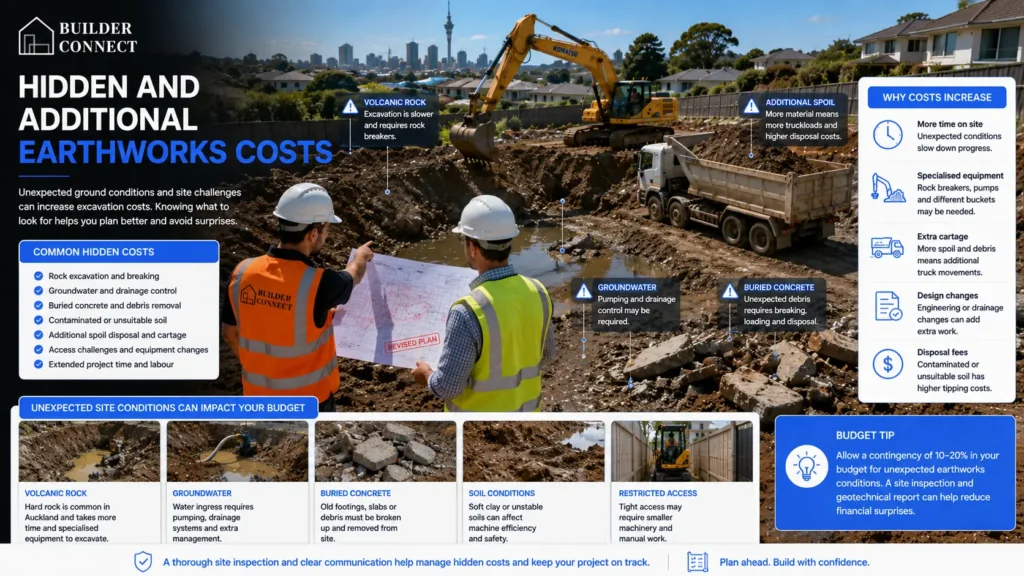
Even when an earthworks quote is carefully prepared, there are situations that can increase the final cost once work begins. Many of these expenses are difficult to identify before excavation starts because they depend on what is found beneath the surface or how the site performs during construction. Understanding these potential costs before accepting a quote can help you build a more realistic budget, compare contractors fairly, and reduce the risk of unexpected variations during your project.
Unexpected Rock Or Hard Material
Rock is one of the most common reasons an earthworks project becomes more expensive than originally expected. While some sites have relatively soft soil that can be excavated quickly, others contain volcanic rock, large buried boulders, reinforced concrete, or other hard materials that require specialised equipment and additional labour.
Breaking through rock is much slower than excavating ordinary soil. Contractors may need to replace standard excavator buckets with hydraulic rock breakers or other heavy-duty attachments designed to fracture hard ground. This process increases operating time and places greater wear on machinery.
Additional costs may include:
- Rock-breaking equipment: Hydraulic breakers and specialised attachments increase equipment hire and operating costs.
- Slower excavation: Progress is significantly slower than standard excavation, increasing labour and machine hours.
- Machine wear: Hard ground places greater stress on excavators, buckets, pins, and hydraulic systems, increasing maintenance costs.
- Noise controls: Some sites may require work to be completed during approved hours to minimise disruption, particularly in residential areas.
- Additional haulage: Rock is heavier than ordinary soil, which may require more truck movements depending on weight restrictions.
- Disposal differences: Broken rock may be accepted at different disposal facilities than general excavated soil, resulting in different tipping charges.
Because underground conditions cannot always be confirmed before excavation starts, contractors often identify rock excavation as a potential variation within their quotation.
Contaminated Soil
Not all excavated material can be disposed of in the same way. If soil is suspected to contain contaminants from previous land use, additional investigation may be required before it can be transported or accepted at a disposal facility.
The level of assessment depends on the site’s history and the requirements of the receiving disposal facility. In some cases, laboratory testing may be needed to determine how the material should be classified before removal.
Potential costs can include:
- Testing: Soil samples may need laboratory analysis before excavation or disposal.
- Classification: Test results determine how the excavated material should be managed.
- Handling requirements: Some materials require separate stockpiling, loading, and transport procedures.
- Approved disposal: Certain disposal facilities only accept material that meets their acceptance criteria.
- Documentation: Disposal facilities may require supporting documentation before accepting excavated material.
- Higher tipping fees: Material requiring specialist handling often attracts higher disposal charges than clean fill.
If there is any uncertainty about previous industrial activity, filled land, or historical site use, discussing this with your contractor before work begins can help identify potential costs earlier in the planning process.
Groundwater And Dewatering
Groundwater can significantly affect excavation work, particularly on low-lying sites or after periods of heavy rain. Water entering an excavation can slow progress, reduce visibility, and make it more difficult to achieve stable working conditions.
Removing groundwater often requires temporary pumping while excavation continues. Additional drainage measures may also be necessary to control water movement around the work area and reduce sediment leaving the site.
Costs may increase because of:
- Water entering excavations: Continuous groundwater inflow can interrupt excavation activities.
- Pumps: Temporary pumping equipment may be required throughout construction.
- Temporary drainage: Additional drainage channels or diversion methods may help manage surface water.
- Sediment controls: Pumped water may require sediment management before discharge where appropriate.
- Delays: Wet conditions often reduce productivity and increase machine operating hours.
- Soil instability: Saturated ground can become unstable, requiring additional care during excavation and backfilling.
Groundwater conditions are not always predictable, particularly before excavation exposes deeper soil layers.
Imported Fill And Aggregate
Many earthworks projects require more than simply removing soil. Once excavation has been completed, suitable materials often need to be brought back onto the site to create stable foundations, improve drainage, or achieve the required finished levels.
The cost depends on both the type and quantity of material required, along with transport and installation.
Common imported materials include:
- Hardfill: Used to build up levels and provide a stable foundation beneath structures.
- Drainage metal: Installed around drainage systems and retaining walls to improve water movement.
- Topsoil: Used for final landscaping and lawn preparation after construction.
- Engineered fill: Selected and compacted to meet engineering requirements for structural support.
- Bedding material: Provides support beneath underground services such as drainage pipes.
- Delivery: Transport costs vary depending on supplier location and load size.
- Spreading: Machinery and labour are required to place material evenly across the site.
- Compaction: Proper compaction helps achieve stable ground and reduces future settlement.
Imported materials should always be suitable for their intended purpose rather than simply choosing the lowest-cost option.
Erosion And Sediment Control
Excavation exposes bare soil, making it easier for rainwater to carry sediment into nearby roads, drains, and waterways. Temporary erosion and sediment-control measures help reduce this risk while work is underway.
The amount of protection required depends on the project size, site slope, weather conditions, and local requirements.
Common measures include:
- Silt fences: Help capture sediment before it leaves the work area.
- Stabilised entrances: Reduce mud being tracked onto public roads by construction vehicles.
- Sediment ponds: Collect sediment-laden water before it leaves the site on larger projects.
- Covering stockpiles: Protect exposed soil from wind and heavy rainfall.
- Street cleaning: Removes soil tracked onto surrounding roads during construction.
- Maintenance during rain: Temporary controls often require regular inspection and repair throughout wet weather.
Although these measures add to project costs, they can help maintain a cleaner, safer construction site and reduce interruptions caused by poor site conditions.
Reinstatement Costs
Earthworks often disturb more than just the excavation area. Machinery access, truck movements, and material storage can affect surrounding landscaping and existing surfaces that may need restoration once construction is complete.
Reinstatement work varies depending on the project scope and should be clearly identified within the quotation.
Possible reinstatement costs include:
- Fencing: Repairing or reinstalling temporary or permanent fences removed during construction.
- Lawns: Re-establishing grass damaged by machinery or excavation activities.
- Gardens: Replacing garden beds, mulch, planting, and edging disturbed during the project.
- Driveways: Repairing or resurfacing damaged concrete, asphalt, or gravel accessways.
- Paths: Reinstating pedestrian access around the property.
- Drainage: Restoring existing drainage systems affected by excavation.
- Kerbs: Repairing vehicle crossings or kerb areas damaged during truck access.
- Damaged access areas: Restoring surfaces affected by repeated machinery movement.
- Site cleaning: Removing surplus materials, debris, and construction waste before project completion.
Clarifying exactly what reinstatement work is included in the quote helps prevent misunderstandings once excavation has finished.
Project Delays And Variations
Even well-planned earthworks projects can experience delays that affect both the schedule and the final cost. While experienced contractors work to minimise disruptions, some factors remain outside anyone’s direct control.
Common causes of delays include:
- Bad weather: Heavy rainfall can make excavation unsafe and prevent machinery from operating efficiently.
- Design changes: Changes requested after excavation has started may require additional work.
- Inspections: Construction may pause while waiting for engineering or council inspections where required.
- Service conflicts: Unexpected underground services can require redesign or relocation before work continues.
- Unsuitable soil: Weak or unstable ground may require additional excavation or imported engineered fill.
- Restricted working hours: Some sites have limited construction hours that extend the overall programme.
- Neighbour-access issues: Shared driveways or limited property access can delay machinery movement.
- Unavailable disposal sites: High demand or operational changes at disposal facilities can affect transport schedules.
Discussing how variations are managed before work begins is just as important as comparing the quoted price. A clear explanation of variation procedures, communication, and approval processes helps reduce uncertainty if unexpected site conditions arise.
Planning for hidden costs does not mean every project will exceed its budget, but understanding where additional expenses may occur allows you to make informed decisions and prepare realistic allowances before excavation begins. A detailed site assessment and a transparent quotation remain the best ways to reduce surprises and keep your project on track.
How To Estimate An Earthworks Budget
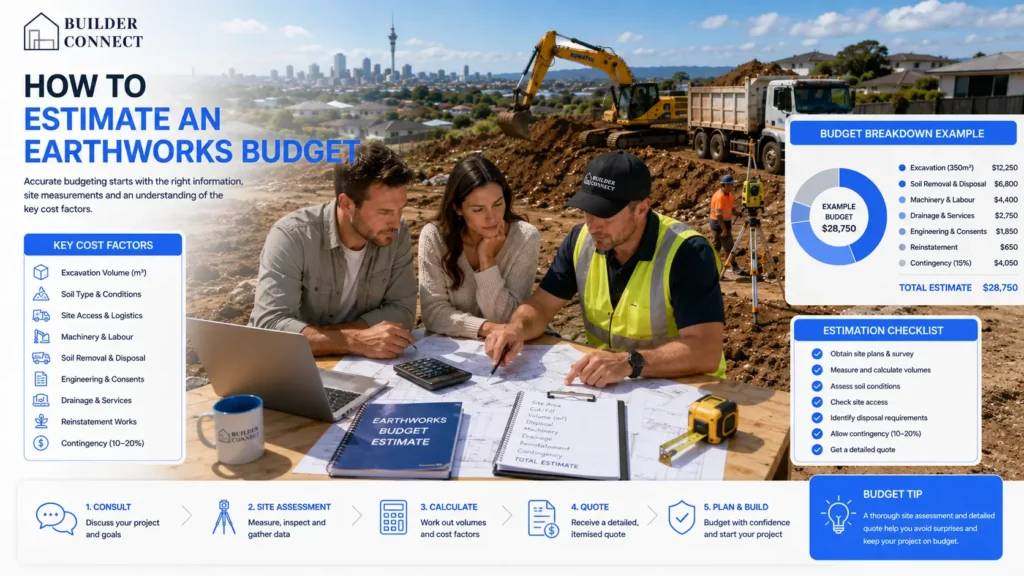
Estimating an earthworks budget is about understanding the full scope of the project rather than relying on a simple online calculator. Every site has different conditions that influence excavation costs, from the amount of soil being removed to the ease of accessing the property. Breaking the project into individual cost components allows you to prepare a more realistic budget and compare contractor quotes with greater confidence.
Step 1: Define The Scope
The first step is to clearly define exactly what work needs to be completed. A well-prepared project scope helps contractors provide more accurate pricing and reduces the likelihood of unexpected costs later.
Before requesting quotes, document as much information as possible about the project, including:
- Excavation area: Measure the approximate length and width of the area that requires excavation.
- Approximate depth: Estimate how deep the excavation needs to be, even if it is only a rough figure.
- Soil destination: Decide whether excavated soil will remain on-site or need to be transported to an approved disposal facility.
- Required finished level: Identify the final ground level required once excavation is complete.
- Known services: Record the location of underground utilities such as water, sewer, stormwater, gas, power, and telecommunications where known.
- Access width: Measure gates, driveways, or side access to determine what machinery can reach the work area.
- Proposed construction: Explain what will be built after the excavation, such as a house foundation, retaining wall, driveway, swimming pool, or drainage system.
- Engineering information: Include any engineering drawings, geotechnical reports, surveys, or construction plans that are available.
The more complete this information is, the fewer assumptions a contractor needs to make when preparing a quotation. This often results in more accurate pricing and fewer variations once work begins.
Step 2: Estimate The Soil Volume
Once the project scope has been defined, estimate how much material will need to be excavated. This provides a useful starting point for understanding excavation, transport, and disposal costs.
A simple formula is:
Length × Width × Average Depth = Approximate Cubic Metres
For example, an excavation measuring 12 metres long, 6 metres wide, and 1 metre deep would contain approximately 72 cubic metres of material.
While this calculation is useful, it should never be treated as the final excavation volume. Real construction sites rarely have perfectly square or level excavation areas, and several factors can significantly change the total amount of material that needs to be handled.
These include:
- Irregular shapes: Curved boundaries, stepped excavations, and uneven site layouts make volume calculations more complex.
- Sloping ground: Average depth may vary across the site, increasing or reducing the actual excavation volume.
- Bulking after excavation: Soil expands once it is excavated because it is no longer compacted. This means more truck space may be required than the in-ground volume suggests.
- Unsuitable material: Poor-quality fill, contaminated soil, buried debris, or soft ground may need to be removed and replaced.
- Over-excavation: Contractors occasionally excavate beyond the planned dimensions to achieve stable foundations or suitable bearing conditions.
- Backfill requirements: Some excavated material may be reused, while other projects require imported fill or drainage aggregate after excavation is complete.
Because of these variables, contractors often confirm excavation volumes during site inspections rather than relying solely on simple calculations.
Step 3: Add Removal And Disposal Costs
Excavating the soil is only part of the overall project cost. Removing material from the site and disposing of it legally can represent a significant portion of the total budget, particularly for larger residential developments.
Several individual costs contribute to soil removal:
- Loading: Excavated material must be loaded into trucks or trailers using suitable machinery.
- Truck travel: Transport costs depend on the distance between the site and the disposal facility.
- Tipping fees: Disposal facilities charge different rates depending on the type and quantity of material being delivered.
- Soil classification: Clean fill, clay, rock, mixed construction waste, and contaminated material are often charged at different disposal rates.
- Truck waiting time: Delays caused by traffic, limited access, or waiting at disposal sites may increase labour and equipment costs.
- Multiple loads: Larger projects may require numerous truck movements, increasing both transport costs and project duration.
Some contractors include disposal costs within a fixed-price quotation, while others list them separately. Understanding exactly what has been allowed for makes it much easier to compare competing quotes.
Step 4: Add Professional And Consent Costs
Earthworks projects often involve expenses beyond excavation and machinery hire. Depending on the size, location, and complexity of the project, professional services and regulatory requirements may form an important part of the overall budget.
Potential costs may include:
- Surveys: Site surveys establish existing ground levels and property boundaries before excavation begins.
- Reports: Geotechnical or environmental reports may be required to assess soil conditions or identify potential risks.
- Engineering: Structural or civil engineers may prepare excavation designs, retaining details, drainage plans, or construction specifications.
- Council applications: Some projects require resource consent, building consent, or other council approvals before work can commence.
- Inspections: Council or engineering inspections may be required at various stages of the project.
- Testing: Soil compaction tests, contamination assessments, or drainage testing may be necessary depending on the project.
- Traffic management: Projects located beside busy roads or public areas may require approved traffic-management plans to protect workers and the public.
Not every residential project will require all of these services, but allowing for them during the planning stage helps prevent unexpected budget increases later.
Step 5: Include A Contingency
Even with careful planning, excavation work involves a degree of uncertainty because many site conditions remain hidden until work begins.
A contingency allows for issues that cannot reasonably be identified during the quoting stage, such as buried concrete, unexpected rock, poor ground conditions, additional drainage requirements, or underground services that differ from available plans.
The appropriate contingency depends on the level of uncertainty associated with the project. A straightforward excavation on a flat, well-investigated residential section with excellent access generally carries less risk than a steep site with limited access, unknown soil conditions, or nearby structures requiring careful excavation.
Rather than applying the same contingency allowance to every project, assess the level of complexity, available site information, and potential construction risks. This approach creates a more realistic budget and provides greater flexibility if unexpected conditions arise during the earthworks.
Planning an earthworks budget carefully before requesting quotations gives you a stronger understanding of where your money is being spent and helps you make informed decisions throughout the project. A well-prepared budget also makes it easier to compare contractors fairly and reduces the likelihood of costly surprises once excavation begins.
How To Get An Accurate Earthworks Quote
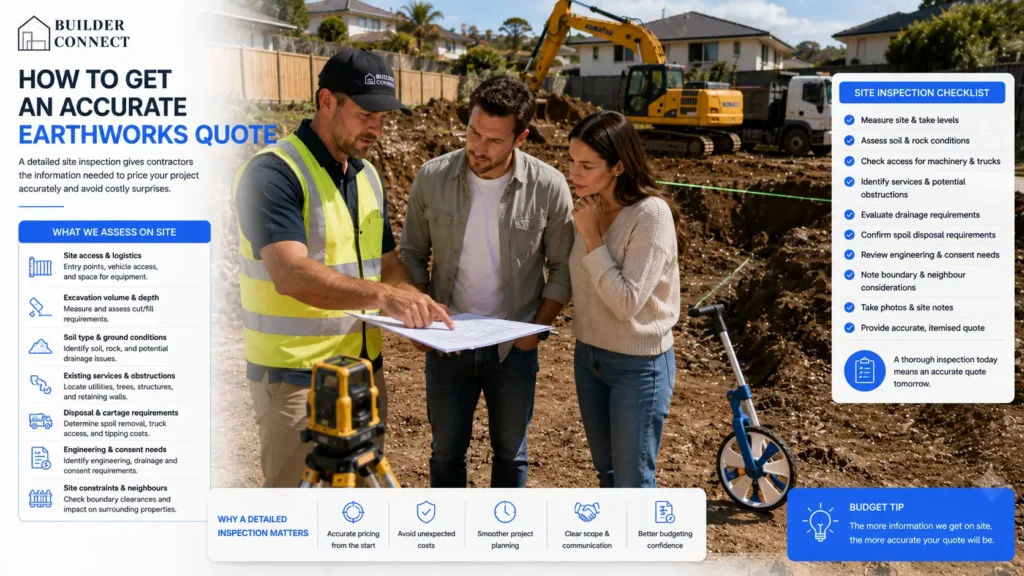
Obtaining an accurate earthworks quote involves much more than requesting a rough estimate over the phone or sending a few photos. Every property has different ground conditions, access challenges, drainage requirements, and construction goals that can significantly affect the final price. A detailed quotation allows you to understand exactly what work is included, compare contractors fairly, and reduce the risk of unexpected costs once excavation begins. Investing time in preparing the right information before requesting quotes often leads to more accurate pricing and a smoother construction process.
Arrange A Site Inspection
A site inspection gives the contractor the opportunity to assess conditions that simply cannot be measured from photographs or satellite images. While photos can provide a general overview, they rarely capture the details that influence excavation methods, machinery selection, project duration, and overall cost.
During an inspection, the contractor can evaluate the physical characteristics of the property and identify potential challenges before preparing a quotation.
Some of the key factors assessed during a site visit include:
- Access limitations: Narrow driveways, restricted side access, gates, fences, mature trees, or neighbouring structures may limit the size of machinery that can enter the property.
- Slope: Sloping sections often require staged excavation, additional safety measures, or specialised equipment that can affect labour and machinery costs.
- Overhead hazards: Power lines, tree branches, balconies, and other overhead obstacles may restrict excavator movement or require alternative working methods.
- Soil conditions: Clay, rock, loose fill, saturated ground, or unstable soil may only become apparent through an on-site assessment and can significantly influence excavation costs.
- Retaining needs: Excavation near existing retaining walls, boundaries, or buildings may require temporary support, engineering input, or additional excavation planning.
- Truck positioning: Contractors need suitable locations for trucks to load and remove excavated material efficiently while maintaining safe access to the site.
- Drainage issues: Existing stormwater systems, natural water flow, groundwater, and low-lying areas may require drainage solutions before excavation can safely begin.
An on-site inspection also allows homeowners to discuss the project directly with the contractor, ask questions, and clarify expectations before work starts.
Provide Complete Plans And Reports
The more accurate information you provide, the more accurate your earthworks quotation is likely to be. Complete documentation reduces guesswork and allows contractors to calculate excavation volumes, machinery requirements, labour, and potential risks more confidently.
Depending on the project, providing the following documents can improve pricing accuracy:
- Architectural plans: Show the proposed building footprint, finished floor levels, driveway layout, and surrounding structures.
- Engineering drawings: Provide technical details for foundations, retaining walls, drainage systems, and structural earthworks.
- Site survey: Supplies accurate site levels, property boundaries, contours, and existing features that affect excavation planning.
- Geotechnical report: Identifies soil conditions, bearing capacity, groundwater, and other information that may influence excavation methods.
- Consent conditions: Helps contractors understand any council requirements that may affect construction or environmental management.
- Service plans: Show the location of underground water, wastewater, stormwater, power, gas, fibre, and telecommunications services that must be protected.
- Erosion-control requirements: Outline sediment-control measures that may be required to manage runoff during excavation.
Providing these documents early allows contractors to prepare detailed quotations based on verified information rather than assumptions.
Ask For An Itemised Scope
A detailed quote should clearly explain what is included and excluded so there is no uncertainty once work begins. Comparing two quotations based only on the total price can be misleading if each contractor has allowed for different amounts of work.
An itemised scope should identify:
- Machinery: The excavators, loaders, trucks, compactors, or specialised equipment included in the project.
- Labour: The number of operators, labourers, drivers, or supervisors allowed for in the quotation.
- Soil volume: The estimated amount of material to be excavated, removed, or relocated.
- Truck movements: The number of truckloads expected for spoil removal or imported materials.
- Disposal: Whether transport, tipping fees, and disposal charges are included.
- Imported materials: Any allowance for hardfill, topsoil, drainage aggregate, or engineered fill.
- Mobilisation: Delivery and collection of machinery to and from the site.
- Exclusions: Any work, materials, permits, or services that are not included in the quoted price.
- Provisional sums: Estimated allowances for work that cannot be accurately priced until excavation begins.
- GST: Confirmation of whether Goods and Services Tax is included or excluded.
- Variation rates: Hourly rates or pricing methods that apply if additional work becomes necessary.
An itemised quotation makes it much easier to understand where your money is being spent and reduces the likelihood of disputes during construction.
Confirm Who Is Responsible For Each Task
Many earthworks projects involve multiple contractors, consultants, utility providers, and council processes. Clarifying responsibilities before work starts helps prevent delays, duplicated work, and unexpected costs.
Before accepting a quote, confirm responsibility for the following:
- Council approvals: Determine whether the contractor or property owner is responsible for obtaining any required approvals.
- Engineering: Confirm who arranges structural or geotechnical engineering where required.
- Utility checks: Establish who will locate underground services before excavation begins.
- Traffic management: Identify who organises any required traffic-control measures if work affects public roads or footpaths.
- Inspections: Clarify who coordinates council, engineering, or compliance inspections throughout the project.
- Soil testing: Confirm responsibility for any geotechnical investigations or contaminated-soil testing.
- Neighbour access: Discuss who will obtain permission if temporary access to neighbouring properties is required.
- Site security: Establish responsibility for securing machinery, excavations, fencing, and public safety during construction.
- Final reinstatement: Confirm who restores lawns, driveways, pathways, gardens, fencing, or disturbed areas once excavation has been completed.
Understanding these responsibilities before signing a contract helps avoid confusion and ensures everyone involved understands their role throughout the project.
Taking the time to organise site information, request detailed documentation, and clarify responsibilities before accepting a quote can save both time and money. A well-prepared quotation provides greater transparency, allows for fair comparisons between contractors, and gives you the confidence to move forward knowing the scope of work has been clearly defined.
How To Compare Earthworks Contractors In Auckland
Choosing an earthworks contractor should involve much more than comparing the lowest price. A cheaper quote may exclude important work, use different assumptions, or leave you responsible for unexpected costs later in the project. The best approach is to compare each contractor based on the full scope of work, relevant experience, safety practices, communication, and the level of detail provided in their quotation. Taking the time to evaluate these factors will help you choose a contractor who can complete the work safely, efficiently, and with fewer surprises.
Compare Like-For-Like Quotes
One of the biggest mistakes property owners make is comparing quotes that cover different scopes of work. Two prices may appear similar, but one contractor may include services that another has excluded. Before making a decision, carefully review every quotation to ensure you are comparing the same work.
When reviewing quotes, check the following:
- Excavation volume: Confirm each contractor has allowed for the same estimated amount of excavation.
- Disposal assumptions: Check whether soil removal, tipping fees, and transport are included or priced separately.
- Imported materials: Verify whether engineered fill, hardfill, topsoil, or aggregate are included where required.
- Machinery: Compare the size and type of excavators, trucks, and supporting equipment proposed for the project.
- Transport: Ensure machinery delivery, removal, and truck transport are clearly included if applicable.
- GST: Confirm whether prices include or exclude GST to avoid misleading comparisons.
- Contingencies: Review how each contractor has allowed for unknown ground conditions or unexpected work.
- Reinstatement: Check whether repairing lawns, driveways, pathways, fences, or landscaped areas forms part of the quoted scope.
If one quotation appears significantly cheaper than the others, ask the contractor to explain exactly what has been included and what has been excluded. Understanding these differences can prevent unexpected costs after work has started.
Check Relevant Project Experience
Earthworks projects can vary greatly depending on the property, soil conditions, and intended construction. A contractor who regularly prepares residential building sites may not have the same experience with steep sections, retaining-wall excavations, or subdivision developments.
Look for contractors who have successfully completed projects similar to yours, particularly if the site presents additional challenges.
Relevant experience may include:
- Sloping Auckland sites: Experience working on steep or uneven sections where excavation requires careful planning and safe machinery operation.
- Narrow residential access: Proven ability to work on properties with limited driveway width, tight side access, or confined working areas.
- Clay and rock: Practical knowledge of Auckland’s common ground conditions and the equipment required to excavate them efficiently.
- Foundation cuts: Experience preparing accurate building platforms and foundation excavations that meet engineering requirements.
- Retaining walls: Familiarity with excavation, drainage, backfilling, and preparation for structural retaining walls.
- Drainage: Experience excavating service trenches and installing drainage systems while maintaining suitable ground levels.
- Subdivisions: Knowledge of larger residential developments involving multiple lots, roads, and staged earthworks.
- Contaminated land: Experience working with contaminated soil where testing, handling, and disposal requirements apply.
Request examples of similar projects, photographs of completed work, or references from previous clients where appropriate. Contractors who regularly perform comparable work are often better prepared to identify potential issues before they become expensive problems.
Review Insurance, Safety And Compliance
Earthworks involve heavy machinery, excavation hazards, underground services, and changing site conditions. Choosing a contractor with strong safety procedures helps protect workers, neighbouring properties, and your investment.
Before accepting a quote, ask about the contractor’s approach to safety and compliance.
Important areas to review include:
- Public-liability insurance: Confirm adequate insurance is in place to cover accidental property damage or third-party claims.
- Health-and-safety systems: Ask how site hazards are identified, managed, and communicated throughout the project.
- Operator experience: Ensure machinery operators are experienced with the equipment and the type of excavation being undertaken.
- Equipment condition: Well-maintained machinery is generally more reliable and less likely to cause costly delays.
- Required licences or registrations: Verify any licences, certifications, or registrations that may apply to the work being performed.
- Written contracts: A written agreement helps define responsibilities, payment terms, project scope, and procedures for handling changes.
Professional contractors are usually happy to discuss these topics because they demonstrate their commitment to quality and safe work practices.
Ask How Variations Are Managed
Even with careful planning, some earthworks projects uncover unexpected conditions after excavation begins. Rock, buried debris, underground services, groundwater, or unstable soil can all require additional work.
Rather than assuming every project will proceed exactly as planned, ask the contractor how variations are managed before signing the contract.
Useful questions include:
- What triggers a variation? Understand which circumstances may result in additional costs.
- Who approves additional work? Confirm that no extra work will proceed without your approval whenever practical.
- What rates apply? Ask whether variations are charged using hourly rates, fixed prices, or another agreed pricing method.
- Will supporting records be provided? Request photographs, measurements, or written explanations that support any additional charges.
- How are disposal volumes confirmed? Clarify how extra soil volumes are measured and documented if excavation exceeds the original estimate.
A clear variation process protects both the contractor and the property owner by reducing misunderstandings and ensuring unexpected work is properly documented.
Review Communication And Documentation
Good communication is often one of the biggest differences between a smooth project and a stressful one. Contractors who provide clear information before, during, and after construction make it easier to understand progress, costs, and any issues that arise.
Before selecting an earthworks contractor, consider how they communicate throughout the quoting process. Prompt responses, detailed quotations, and clear explanations often reflect how they will manage the project itself.
Review the following documentation:
- Written scopes: The quotation should clearly describe the work included and any exclusions.
- Start dates: Confirm when work is expected to begin and whether the date depends on weather, approvals, or previous projects.
- Project timelines: Ask for an estimated construction programme so you understand the expected duration.
- Daily updates: Some contractors provide regular progress updates, particularly on larger projects or where variations occur.
- Site records: Daily records, photographs, and measurements can help document completed work and site conditions.
- Invoices: Ensure invoices clearly identify completed work, approved variations, and payment schedules.
- Variation approvals: Confirm that all changes to scope or pricing will be documented in writing before proceeding.
- Completion documentation: Ask whether the contractor provides final records, inspection reports, or other documentation relevant to the completed work.
Choosing a contractor who communicates clearly from the beginning often leads to fewer misunderstandings, more accurate budgeting, and a smoother overall project experience.
Taking the time to compare contractors carefully can save far more than simply accepting the lowest quote. A detailed scope, relevant experience, transparent pricing, and professional communication often provide better long-term value and help your earthworks project stay on schedule, within budget, and completed to a high standard.

How To Reduce Earthworks Costs Without Cutting Corners
Reducing earthworks costs does not mean choosing the cheapest quote or cutting back on important work. The most cost-effective projects are usually those that are well planned before excavation begins. By identifying potential issues early, coordinating the construction schedule, and making informed decisions, property owners can reduce unnecessary expenses while still achieving a safe, high-quality result.
Complete Site Investigations Early
One of the best ways to control earthworks pricing is to gather as much information about the site as possible before requesting quotes or starting construction. Unknown ground conditions are one of the leading causes of unexpected costs because contractors may discover unsuitable soil, buried services, groundwater, or rock only after excavation has begun.
Early investigations allow contractors to prepare more accurate pricing, reduce uncertainty, and minimise costly variations later in the project.
- Topographical surveys: Show existing ground levels, slopes, boundaries, and site features so excavation quantities can be estimated more accurately.
- Underground service checks: Identify water, sewer, stormwater, gas, electricity, and communication lines before excavation starts, reducing the risk of accidental damage and project delays.
- Geotechnical reports: Provide valuable information about soil strength, stability, groundwater conditions, and foundation suitability. This information helps determine the appropriate excavation methods and machinery.
- Engineering advice: Ensures excavation plans meet structural requirements and identifies areas that may require additional support or specialised construction techniques.
- Accurate planning: Reduces uncertainty during quoting and gives contractors greater confidence when preparing fixed-price proposals.
Although these investigations involve an upfront cost, they often prevent far more expensive surprises once machinery arrives on-site.
Balance Cut And Fill Where Appropriate
Many earthworks projects involve both excavation and filling. Instead of removing all excavated soil from the property and importing new material later, it may be possible to reuse suitable material elsewhere on the site.
When properly designed and approved, balancing cut and fill can reduce truck movements, disposal fees, imported fill costs, and overall project duration.
Not every type of soil is suitable for reuse. Fill material must meet engineering requirements where structural support is needed, and proper compaction is essential to avoid future settlement. In some situations, unsuitable or contaminated soil must still be removed regardless of the potential savings.
Reusing suitable material on-site should always be based on engineering recommendations, project specifications, and applicable council requirements.
Improve Site Access Before Work Starts
Restricted access often increases labour time, limits machinery options, and slows excavation progress. Spending time preparing the site before construction begins can make the work more efficient and reduce overall costs.
Simple improvements to access can help larger equipment operate safely and minimise delays throughout the project.
- Remove temporary obstructions: Clear vehicles, trailers, garden furniture, building materials, and unnecessary equipment from work areas before excavation begins.
- Confirm access rights: Ensure contractors have permission to use shared driveways, neighbouring access routes, or temporary entry points where required.
- Plan truck movements: Identify loading areas, turning space, and entry and exit routes to minimise waiting times and improve productivity.
- Identify overhead hazards: Check for power lines, tree branches, awnings, and other obstacles that could restrict excavator movement or truck access.
- Protect existing surfaces: Use ground protection mats, timber sheets, or other suitable methods where machinery will cross finished driveways, lawns, or paved areas.
Good access planning not only reduces costs but also helps protect the property from avoidable damage during construction.
Coordinate Earthworks With Other Trades
Earthworks are often the first stage of a much larger construction project. Poor communication between contractors can lead to duplicated excavation, unnecessary backfilling, and additional machinery hire.
Coordinating the construction schedule allows each trade to complete its work in the correct sequence, reducing disruption and preventing expensive rework.
For example, drainlayers should usually complete underground pipe installation before final site levelling. Retaining-wall construction may need to be completed before landscaping begins, while foundation excavation should align with the builder’s programme to avoid unnecessary delays.
Good coordination between builders, drainlayers, concrete contractors, landscapers, retaining-wall installers, surveyors, and engineers helps keep machinery on-site only as long as necessary while reducing repeated excavation work.
Avoid Unnecessary Double Handling
Every time soil is moved more than once, additional labour, machinery, fuel, and time are required. Double handling is one of the most common causes of avoidable earthworks costs on residential projects.
Careful planning can significantly reduce unnecessary material movement.
- Moving soil twice: Excavating material into temporary piles before loading it again increases machine hours and truck loading time.
- Poorly placed stockpiles: Stockpiling soil in areas that later block access or require relocation creates additional work that could have been avoided.
- Loading small trucks unnecessarily: Using undersized trucks for large excavation volumes increases the number of trips, fuel consumption, and loading time.
- Returning machinery to the site: Incomplete planning may require excavators or trucks to return after they have already been demobilised, creating additional transport and mobilisation costs.
Planning where excavated material will go before work starts allows contractors to move soil efficiently and complete the project with fewer machine hours.
Finalise Designs Before Excavation
One of the easiest ways to increase construction costs is to change the project after excavation has already started. Even relatively small design changes can require additional excavation, imported fill, extra machinery, revised engineering, and repeated inspections.
Before machinery arrives, confirm the final design for all major site elements, including building locations, finished floor levels, retaining walls, drainage systems, driveways, pathways, and landscaping.
Making decisions early allows contractors to excavate once, complete the work efficiently, and avoid unnecessary variations. It also gives engineers, surveyors, and builders confidence that everyone is working from the same approved plans, reducing delays and helping the project stay within budget.
Careful planning before excavation begins often delivers greater savings than negotiating a lower hourly rate. By understanding site conditions, preparing accurate plans, coordinating trades, and reducing unnecessary rework, homeowners can keep earthworks costs under control while maintaining the quality, safety, and long-term performance of the finished project.
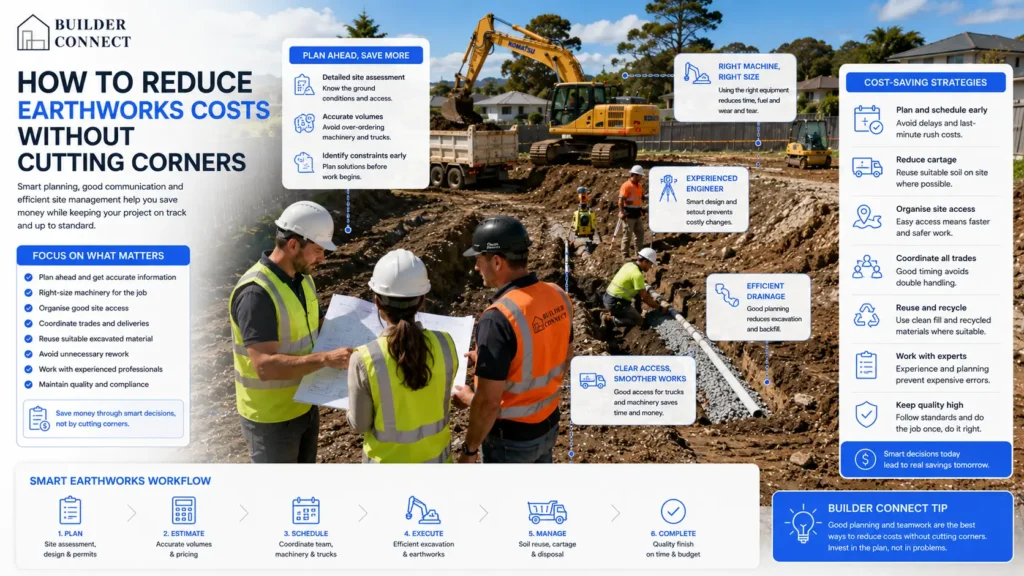
Common Earthworks Pricing Mistakes To Avoid
Even well-planned earthworks projects can become more expensive than expected when important details are overlooked during the quoting or planning stage. Many unexpected costs are not caused by the excavation itself but by assumptions made before work begins. Understanding the most common pricing mistakes can help you compare quotes more accurately, prepare a realistic budget, and reduce the likelihood of costly variations once excavation is underway.
Choosing A Quote Based Only On The Lowest Price
Selecting the cheapest quote may seem like an easy way to save money, but a lower price does not always represent better value. Some quotations appear competitive because certain costs have been excluded or only estimated rather than fully allowed for. If these items become necessary during construction, the final project cost can increase significantly.
When reviewing quotations, look beyond the total price and compare exactly what each contractor has included. A higher quote may provide a more complete scope of work, reducing the risk of unexpected expenses later.
- Disposal Costs: Confirm whether soil removal, transport, tipping fees, and clean-up are included.
- Machinery Transport: Check if machine delivery and collection charges are part of the quoted price.
- Engineering Requirements: Determine whether engineering inspections, reports, or supervision have been included where required.
- Reinstatement Work: Ask whether damaged driveways, lawns, fencing, or landscaping will be restored after excavation.
- Provisional Sums: Understand which items are estimated only and may change once work begins.
A detailed, itemised quote often provides a better basis for comparison than simply choosing the contractor offering the lowest overall price.
Assuming All Excavated Soil Is Clean Fill
Many property owners assume that all excavated soil can be transported to a clean-fill site at a standard disposal rate. In reality, soil is classified according to its condition, composition, and whether it contains contaminants or unsuitable materials.
If soil contains construction waste, concrete fragments, asphalt, vegetation, chemicals, or contaminated material, disposal options may become more limited and expensive. Certain materials require testing before they can be accepted by approved disposal facilities.
Soil classification also influences transport planning, tipping fees, and environmental compliance. Asking your contractor how excavated material will be assessed can help prevent unexpected disposal charges.
- Clean Fill: Usually consists of uncontaminated natural soil that may qualify for lower disposal costs.
- Mixed Material: Soil containing concrete, timber, bricks, or rubbish often attracts higher disposal fees.
- Contaminated Soil: Material containing hazardous substances may require specialist testing, transport, and disposal.
- Site Restrictions: Some disposal facilities only accept specific types of excavated material.
Ignoring Site Access
Access is one of the most overlooked factors affecting earthworks pricing. Two properties requiring the same amount of excavation can have very different costs simply because one site is easy to reach while the other has restricted access.
Narrow driveways, limited side access, overhead power lines, neighbouring structures, retaining walls, and existing landscaping can all affect machinery selection and productivity. Smaller excavators may be required where larger machines cannot enter, increasing excavation time and labour costs.
Restricted access may also require additional handling of excavated material before it reaches waiting trucks, adding further time and expense.
- Machine Size: Limited access may require smaller excavators that complete work more slowly.
- Truck Positioning: Greater distance between excavation and trucks can increase loading time.
- Manual Labour: Some material may need to be moved by hand or with smaller equipment.
- Project Duration: Reduced productivity often extends the overall construction schedule.
Providing photographs, measurements, and arranging a site inspection allows contractors to assess access conditions accurately before preparing a quotation.
Underestimating Soil Volume
Estimating excavation volume is more complicated than multiplying length, width, and depth. Sloping ground, irregular excavation shapes, varying depths, and changes made during construction can all affect the final quantity of material removed.
Another common mistake is forgetting that excavated soil expands once it has been dug out. This process, often referred to as bulking, means loose soil occupies more space than it did when compacted in the ground. As a result, additional truckloads and disposal costs may be required.
Accurate volume estimates reduce the likelihood of significant pricing adjustments during the project.
- Irregular Shapes: Excavations rarely have perfectly straight sides or consistent depths.
- Sloping Sites: Uneven ground makes volume calculations more complex.
- Bulking: Loose excavated soil generally occupies more volume than undisturbed ground.
- Design Changes: Additional excavation requested during construction increases both labour and disposal costs.
Starting Before Plans Are Final
Beginning earthworks before construction drawings, engineering details, or drainage layouts have been finalised can create expensive rework. Changes made after excavation has started may require areas to be re-excavated, backfilled, compacted again, or reshaped to suit revised plans.
Taking time to finalise project documentation before machinery arrives usually results in a smoother construction process and better cost control.
- Level Changes: Altering finished floor or ground levels may require additional excavation.
- Drainage Changes: Updated pipe layouts can require new trenches or deeper excavation.
- Retaining Wall Revisions: Structural changes may affect footing locations and excavation depths.
- Repeated Machine Hire: Returning equipment to site increases labour and transport costs.
Failing To Check Services
Underground services should always be identified before excavation begins. Striking buried infrastructure can create safety risks, costly repairs, and lengthy project delays.
Depending on the property, underground assets may include water pipes, sewer lines, stormwater systems, gas pipes, electrical cables, telecommunications, fibre-optic networks, and irrigation systems. Even older properties can contain abandoned services that remain buried beneath the ground.
Before excavation starts, contractors should confirm service locations using available plans and, where necessary, specialist locating equipment.
- Water Services: Damage can interrupt household water supply and require urgent repairs.
- Power Cables: Underground electrical cables present serious safety hazards.
- Gas Pipes: Gas infrastructure requires careful identification before excavation.
- Drainage Systems: Existing stormwater and wastewater pipes should be protected.
- Fibre And Telecommunications: Communication services can be costly to repair if damaged.
Not Allowing For Weather And Water
Weather conditions play a significant role in earthworks pricing and scheduling, particularly in Auckland where rainfall can change site conditions quickly. Heavy rain can soften the ground, reduce machine productivity, delay truck movements, and make compaction more difficult.
Excess water within an excavation may also require pumping or temporary drainage before work can continue safely. Wet conditions increase the likelihood of soil sticking to machinery, damaging accessways, and creating additional clean-up requirements.
Although experienced contractors plan for seasonal conditions, prolonged rainfall or unexpected groundwater can still affect both project timelines and costs.
- Wet Ground: Saturated soil reduces machinery efficiency and increases excavation difficulty.
- Compaction Delays: Moisture levels may prevent achieving the required ground compaction.
- Transport Issues: Muddy accessways can slow truck movements and create cleaning requirements.
- Water Management: Pumping and temporary drainage may be necessary before excavation can continue.
- Programme Delays: Poor weather can extend project duration and affect the scheduling of following trades.
Understanding these common pricing mistakes makes it much easier to compare quotations, ask informed questions, and prepare a realistic budget before excavation begins. A thorough site assessment, detailed project information, and a transparent quote will help reduce surprises and give you greater confidence throughout your earthworks project.
Get a clearer understanding of your project costs before excavation begins by arranging a detailed on-site assessment with an experienced Auckland earthworks team. A site-specific quote can identify access challenges, soil-removal requirements, machinery needs, and possible extra costs early, helping you plan your budget with greater confidence. Click through to discuss your project, review your site conditions, and request an itemised earthworks estimate tailored to your property.
References
- Bromley Group – How Much Do Earthworks Cost in Auckland? (2026 Guide)
https://www.bromleygroup.co.nz/blog/earthworks-cost-auckland - ASAP Machine Hire & Earthworks – Machine Hire & Earthworks Price List
https://www.asapmachinehire.co.nz/price-list - Auckland Council – Resource Consent Fees and Deposits
https://www.aucklandcouncil.govt.nz/en/building-and-consents/resource-consents/resource-consent-fees-deposits.html - Auckland Design Manual – Earthworks and Geotechnical Requirements
https://www.aucklanddesignmanual.co.nz/content/dam/adm/adm-website/developing-infrastructure/infrastructure-codes-of-practice/chapter-2-earthworks-and-geotechnical-requirements/CoP_Chapter_2_v2.pdf - Ministry for Primary Industries – RMA: Earthworks on Land (Ground Rules)
https://www.groundrules.mpi.govt.nz/rule/3387-rma-earthworks-on-land
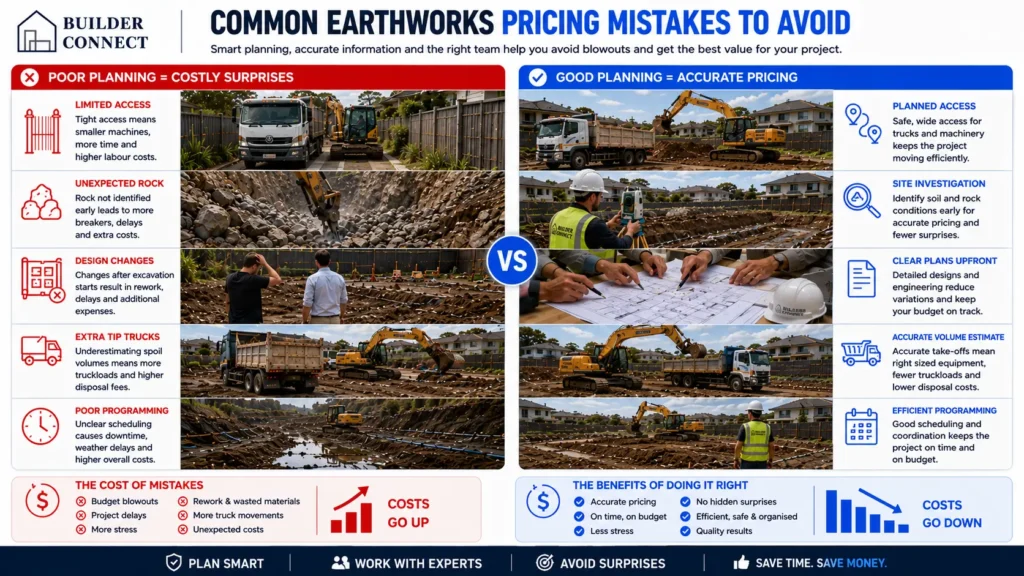
FAQs: About Earthworks Pricing Auckland
Conclusion
Earthworks pricing in Auckland depends on far more than simply the amount of soil being excavated. Factors such as site access, ground conditions, excavation volume, machinery selection, soil removal and disposal, engineering requirements, consent obligations, and final reinstatement all play an important role in determining the total project cost. Taking the time to prepare accurate plans, engineering reports, site information, access details, and a clear project scope before requesting quotes will help contractors provide a more accurate and transparent estimate while reducing the likelihood of unexpected costs later. If you are planning an earthworks project, arranging a professional site assessment and requesting a detailed, itemised quote is one of the best ways to understand your budget, compare contractors fairly, and move forward with confidence on your Auckland property.
Find A Professional Earthworks Company Near You!
Earthworks Auckland
Call now: 09 886 7219 Main Menu ServicesReviewsBenefitsOur Work Call For Instant Quote 09 886…
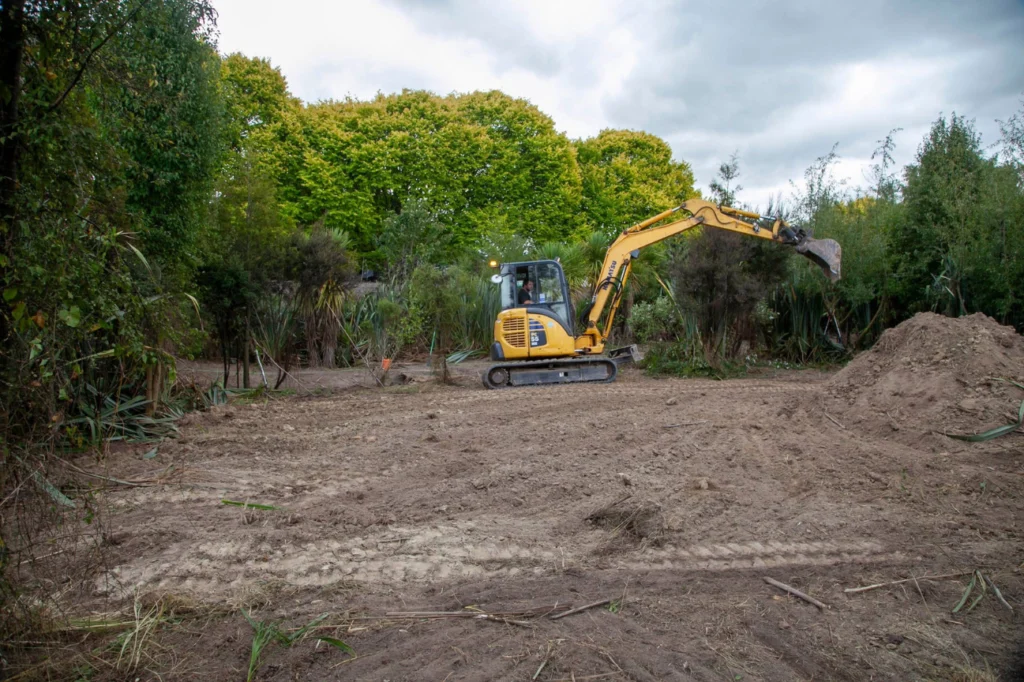
Earthworks Manawatu
Call now: 06 880 3042 Main Menu ServicesReviewsBenefitsOur Work Call For Instant Quote 06 880…
Earthworks North Shore
Call now: 09 886 7219 Main Menu ServicesReviewsBenefitsOur Work Call For Instant Quote 09 886…
Earthworks Coromandel, Waihi, and Paeroa
Call now: 07 809 4533 Main Menu ServicesReviewsBenefitsOur Work Call For Instant Quote 07 809…
Earthworks Dannevirke
Call now: 06 888 0075 Main Menu ServicesReviewsBenefitsOur Work Call For Instant Quote 06 888…
Earthworks Waikato
Call now: 07 808 1249 Main Menu ServicesReviewsBenefitsOur Work Call For Instant Quote 07 808…

About the Author:
Mike Veail is a recognized digital marketing expert with over 6 years of experience in helping tradespeople and small businesses thrive online. A former quantity surveyor, Mike combines deep industry knowledge with hands-on expertise in SEO and Google Ads. His marketing strategies are tailored to the specific needs of the trades sector, helping businesses increase visibility and generate more leads through proven, ethical methods.
Mike has successfully partnered with numerous companies, establishing a track record of delivering measurable results. His work has been featured across various platforms that showcase his expertise in lead generation and online marketing for the trades sector.
Learn more about Mike's experience and services at https://theleadguy.online or follow him on social media: