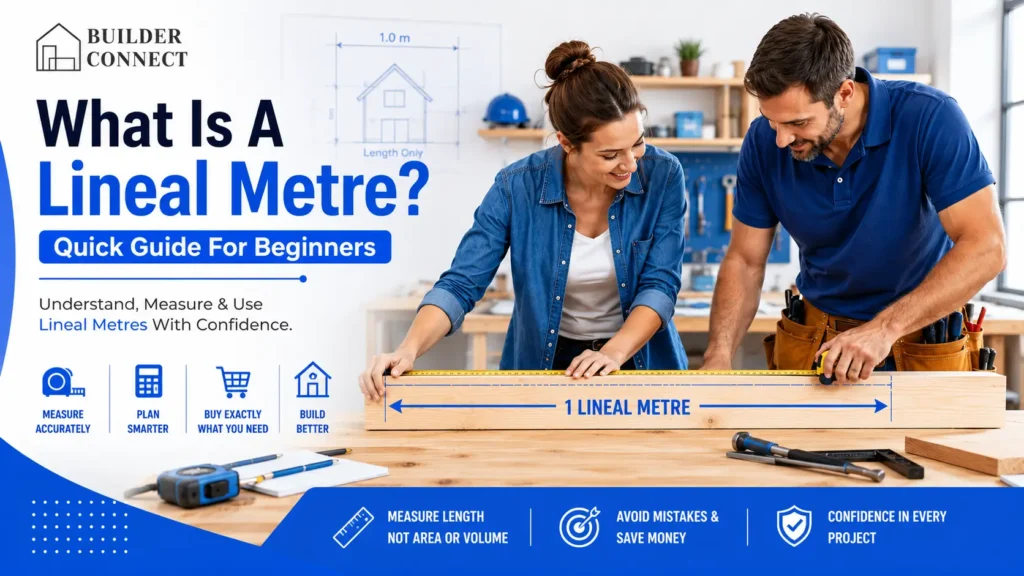
Welcome to your simple, no-confusion guide to understanding what a lineal metre is and why it matters in everyday situations like construction, DIY projects, and buying materials. If you’ve ever been unsure whether you need a lineal metre, square metre, or something else entirely, you’re not alone, and this guide will clear it up quickly. You’ll learn exactly what a lineal metre means, how it’s used in real-world scenarios, and how to measure it correctly so you can avoid costly mistakes and make confident decisions when planning or purchasing materials.
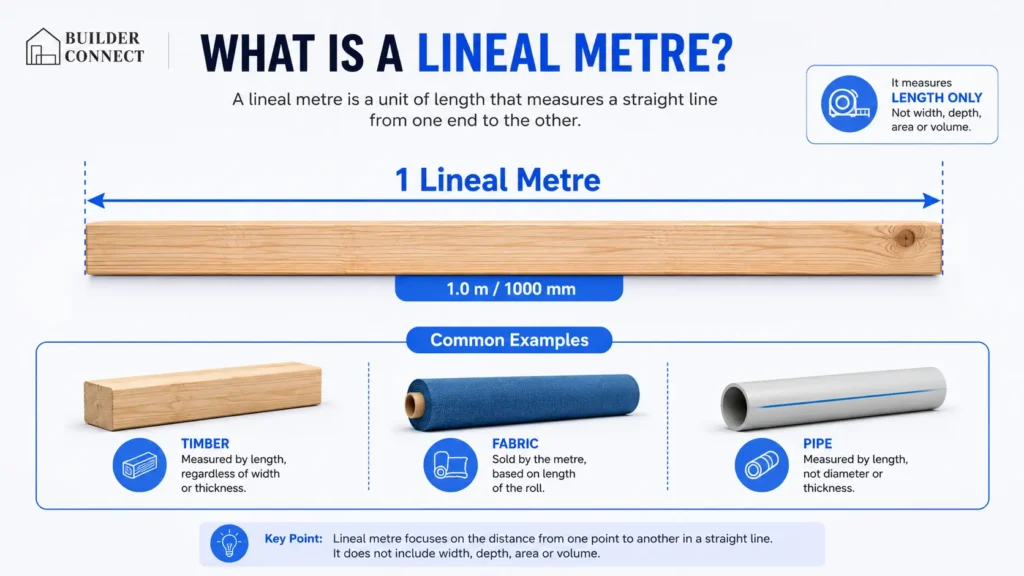
A lineal metre is a unit of measurement that refers to one metre in length measured in a straight line, regardless of width or thickness. It is commonly used to measure materials like timber, fabric, pipes, and fencing where only length matters, not area or volume.
- What Does “Lineal Metre” Mean?
- Why Lineal Metres Matter In Everyday Situations
- Lineal Metre vs Square Metre vs Cubic Metre
- How To Calculate A Lineal Metre
- Real-World Examples Of Lineal Metres
- When Should You Use Lineal Metres?
- Common Questions About Lineal Metres
- Tips For Measuring Accurately
- References
- FAQs: About What Is A Lineal Metre
- Conclusion
- Find A Professional Builders Company Near You!
What Does “Lineal Metre” Mean?
Understanding what a lineal metre means is essential if you are working with materials where length is the main factor. This term often appears in construction, DIY projects, and retail settings, and while it sounds technical, the concept itself is straightforward once broken down clearly.
Simple Definition
A lineal metre simply refers to one metre measured in a straight line. It focuses only on the length of an object, regardless of how wide, thick, or tall that object may be. Think of it as measuring how long something is from one end to the other without considering any other dimension.
In practical terms, if you are buying a 5 metre piece of timber, you are purchasing 5 lineal metres, even if the timber has a specific width and thickness. The measurement is purely about length, making it easy to understand and apply in everyday situations.
Key Idea: It Measures Length, Not Area or Volume
The most important concept to remember is that a lineal metre measures length only. It does not account for surface area or space occupied, which is where many people get confused.
- Length-only focus: A lineal metre measures distance from one point to another in a straight line
- No width included: The width of the material does not change the lineal metre measurement
- No thickness considered: Thickness or depth is irrelevant to this type of measurement
- Different from area: Square metres measure surface area, such as floors or walls
- Different from volume: Cubic metres measure three dimensional space, such as storage or concrete
For example, two pieces of timber that are both 2 metres long but have different widths will still be considered 2 lineal metres each. The variation in width does not affect the measurement.
“Lineal Metre” vs “Linear Metre” Are They the Same?
You will often see both “lineal metre” and “linear metre” used in different contexts, and this can create confusion. In most cases, these terms mean the same thing and can be used interchangeably.
- Linear metre: This is the technically correct term and is more commonly used in formal or technical settings
- Lineal metre: This is a widely accepted variation, often used in retail, construction, and everyday language
- Same measurement concept: Both terms refer to a straight line measurement of one metre in length
- Regional preference: Some industries or regions may prefer one term over the other, but the meaning does not change
In practice, whether a supplier lists materials in lineal metres or linear metres, you are still dealing with the same length-based measurement. What matters most is understanding that both refer to measuring length in a straight line, which allows you to confidently interpret product descriptions and measurements.
Understanding the meaning of a lineal metre makes it much easier to work with length-based measurements in real-world situations, helping you avoid confusion and approach projects with greater confidence.
Why Lineal Metres Matter In Everyday Situations
Understanding lineal metres is not just a technical detail, it plays a practical role in how materials are measured, priced, and used across many industries. Whether you are planning a home project or purchasing materials, knowing how lineal measurement works helps you avoid confusion, reduce waste, and make more accurate decisions.
Common Industries That Use Lineal Metres
Lineal metres are widely used in industries where materials are sold or installed based on length rather than area or volume. This approach keeps measurements straightforward and ensures consistency across projects.
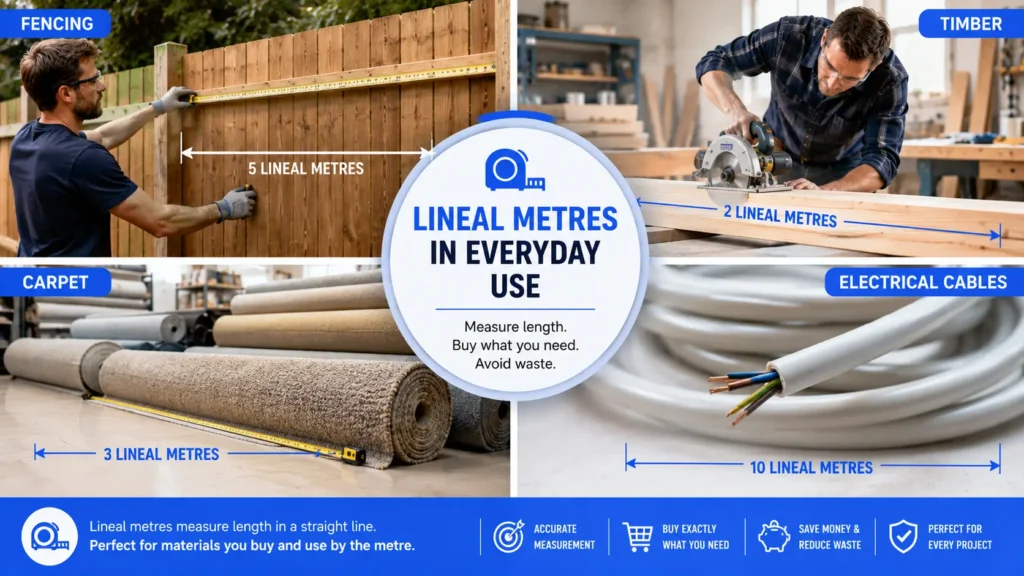
- Construction: Builders rely on lineal metres when working with timber, pipes, and beams because these materials are typically cut and installed based on length. For example, framing timber or plumbing pipes are measured this way to match structural requirements.
- Retail: Stores selling fabric, carpets, and cables often price products per lineal metre. This allows customers to purchase exactly the length they need without worrying about calculating total surface coverage.
- Landscaping: Projects involving fencing, garden edging, or borders use lineal metres to measure perimeter length. This ensures materials fit the layout of the space without unnecessary excess.
- Logistics: Freight companies may use lineal metres to calculate how much space goods occupy in a truck or container, especially for long or irregular items that do not fit standard volume measurements.
Why Businesses Price By Lineal Metre
Pricing by lineal metre simplifies transactions for both businesses and customers when dealing with long, continuous materials. Instead of factoring in multiple dimensions, suppliers can offer a clear and consistent pricing model based solely on length.
- Simplified pricing structure: Charging per metre eliminates the need for complex calculations, making it easier for customers to understand costs upfront.
- Flexible purchasing: Customers can buy the exact length required, which reduces overbuying and helps control project budgets.
- Standardized measurement: Using a single unit of length ensures consistency across different products and suppliers, especially in industries like construction and manufacturing.
Practical Benefits Of Using Lineal Measurements
Using lineal measurements offers several real-world advantages, particularly for projects that depend on precise lengths and efficient material use.
- Accuracy in planning: Measuring in lineal metres helps you calculate exact material requirements, which reduces guesswork and improves project outcomes.
- Reduced material waste: By ordering only what you need in terms of length, you minimize offcuts and leftover materials.
- Ease of calculation: Lineal measurements are straightforward to add and convert, making them ideal for quick estimates and on-site adjustments.
- Better cost control: Clear length-based pricing allows you to budget more effectively and avoid unexpected expenses during a project.
Understanding how lineal metres are used in everyday situations makes it easier to plan, purchase, and execute projects with confidence, whether you are working on a small DIY task or a large-scale build.
Lineal Metre vs Square Metre vs Cubic Metre
Understanding the difference between a lineal metre, square metre, and cubic metre is essential if you want to measure materials accurately and avoid costly mistakes. Each unit measures something completely different, and using the wrong one can lead to over-ordering, under-ordering, or choosing the wrong type of material for your project. Let’s break each one down in a simple, practical way so you can confidently apply the right measurement in real-world situations.
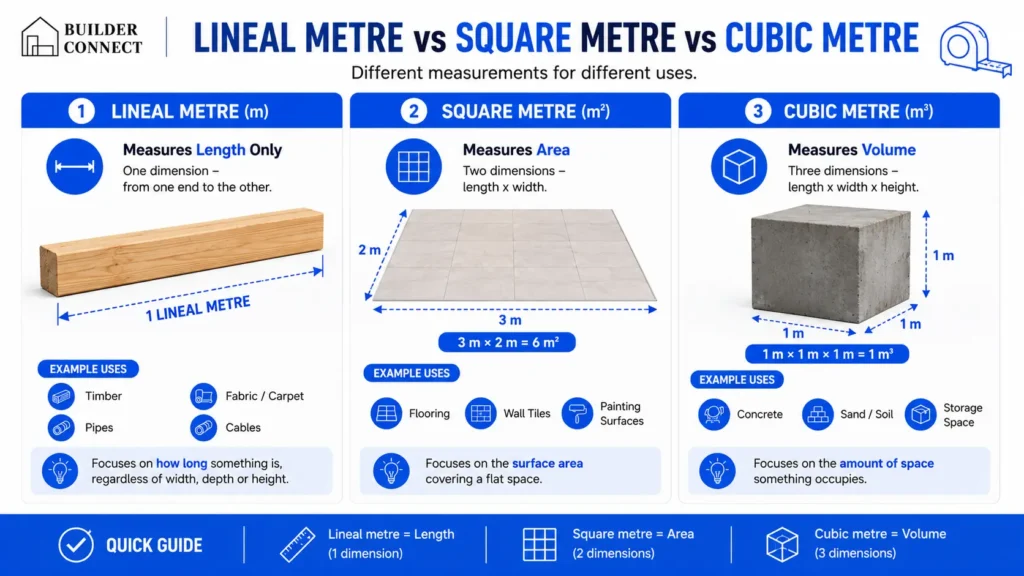
Lineal Metre (Length)
A lineal metre measures length in a straight line and does not take into account width or thickness. It is commonly used for materials that are sold or installed based on how long they are rather than how much space they cover.
- Definition: A lineal metre equals one metre in length, measured from one end to the other
- Best use case: Ideal for items like timber, pipes, cables, fencing, and skirting boards
- Key characteristic: Only length matters, so dimensions like width and height do not affect the measurement
- Real-world example: If you need 10 metres of fencing, you are measuring 10 lineal metres regardless of fence height
This measurement works best when dealing with long, continuous materials where coverage area is not the main concern.
Square Metre (Area)
A square metre measures area, which means it accounts for both length and width. This is the standard unit used when you need to know how much surface space something covers.
- Definition: A square metre is the area of a square that measures one metre by one metre
- Best use case: Used for flooring, tiles, carpets, paint coverage, and wall surfaces
- Key characteristic: Both length and width are required to calculate the total area
- Real-world example: A room that is 5 metres long and 4 metres wide has an area of 20 square metres
Square metres are essential when coverage matters, especially in projects involving surfaces.
Cubic Metre (Volume)
A cubic metre measures volume, which includes length, width, and height. It is used when you need to calculate how much space something occupies in three dimensions.
- Definition: A cubic metre is the volume of a cube that measures one metre on each side
- Best use case: Commonly used for concrete, soil, gravel, water, and shipping space
- Key characteristic: Requires three dimensions to determine the total volume
- Real-world example: A container that is 2 metres long, 1 metre wide, and 1 metre high holds 2 cubic metres
This measurement is critical when dealing with bulk materials or storage capacity.
Quick Comparison Table for Clarity
| Measurement Type | What It Measures | Dimensions Required | Common Uses |
| Lineal Metre | Length | Length only | Timber, fencing, cables |
| Square Metre | Area | Length and width | Flooring, tiles, paint |
| Cubic Metre | Volume | Length, width, height | Concrete, soil, shipping |
This table helps highlight how each unit serves a different purpose depending on what you are measuring.
Common Mistakes People Make
Many measurement errors happen because people assume these units are interchangeable when they are not. Understanding where confusion typically occurs can help you avoid expensive miscalculations.
- Flooring confusion: People often try to measure flooring in lineal metres when it should be calculated in square metres, leading to incorrect coverage estimates
- Skirting board mix-ups: Skirting boards are measured in lineal metres, but some mistakenly calculate them using square metres, which is unnecessary and inaccurate
- Quantity errors: Ordering materials without confirming the correct unit can result in too much or too little material, increasing costs and delays
- Conversion mistakes: Attempting to convert between units without the correct dimensions can lead to inaccurate results
A simple rule to follow is this: use lineal metres for length, square metres for surface area, and cubic metres for volume, and always double-check what your supplier requires before placing an order.
Understanding these differences gives you a practical advantage, helping you plan better, measure accurately, and avoid common pitfalls that can impact both budget and project outcomes.
How To Calculate A Lineal Metre
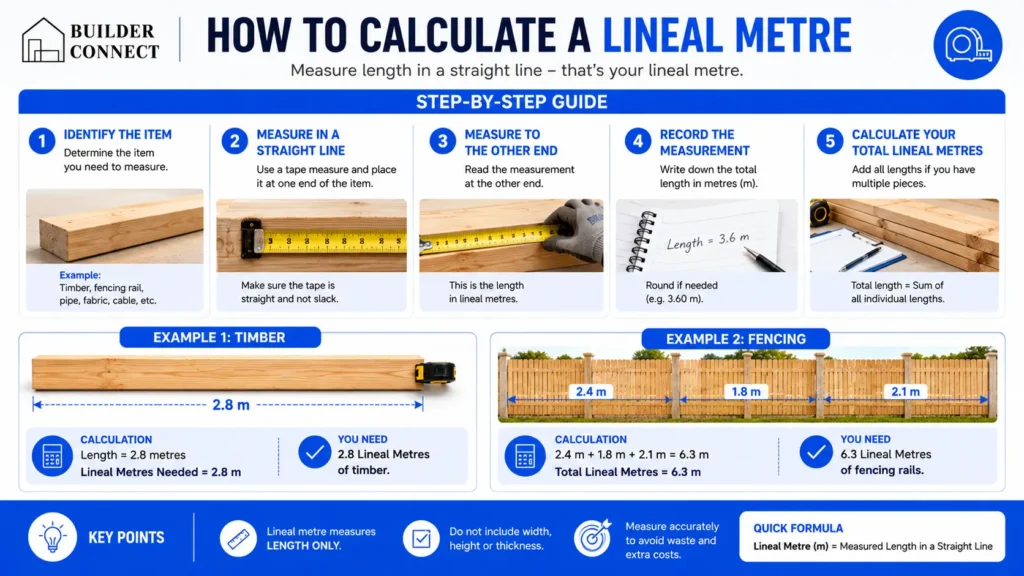
Understanding how to calculate a lineal metre is straightforward once you focus on one key idea: you are only measuring length. There is no need to consider width, thickness, or depth unless you are converting from another unit. This section breaks down the process into simple, practical steps you can apply to real-world projects.
Basic Formula (Length Only)
At its core, calculating a lineal metre is as simple as measuring length in metres. There is no complex formula involved, which is why this unit is commonly used in construction and material purchasing.
- Definition: A lineal metre equals one metre of length measured in a straight line
- Formula: Total lineal metres = sum of all lengths in metres
- Key principle: Only the length matters, regardless of the material’s width or thickness
For example, if you have a piece of timber that is 3 metres long, it is simply 3 lineal metres. If you have two pieces, each 3 metres long, your total becomes 6 lineal metres.
Step-By-Step Example (Simple Measurement)
To make this clearer, here is a practical, step-by-step way to calculate lineal metres for a simple project.
- Step 1: Measure the length of the material using a tape measure
- Step 2: Record the measurement in metres
- Step 3: If needed, convert smaller units into metres
- Step 4: Use the measurement directly as your lineal metre value
Example:
If you are installing a fence that runs 8 metres along your property line, you need 8 lineal metres of fencing material. The process is direct because only the length of the fence matters.
Measuring Irregular Or Multiple Lengths
In many real-world situations, you will not be working with a single straight length. You may have multiple sections or irregular shapes that need to be measured separately.
Adding Segments Together
When dealing with multiple lengths, you simply measure each section and add them together to get the total lineal metres.
- Separate measurements: Measure each section individually rather than estimating the total
- Consistent units: Ensure all measurements are in metres before adding
- Accurate totals: Add all segments to get the final lineal metre value
Example:
If you are measuring skirting boards around a room:
- Wall 1 = 4 metres
- Wall 2 = 3 metres
- Wall 3 = 4 metres
- Wall 4 = 3 metres
Total = 14 lineal metres
This approach ensures accuracy, especially when working with uneven layouts or multiple surfaces.
Converting From Other Units (Cm, Mm, Feet)
Sometimes measurements are not given in metres, so you will need to convert them before calculating lineal metres. This is a common step when working with product specifications or international measurements.
- Centimetres to metres: Divide by 100
- Millimetres to metres: Divide by 1,000
- Feet to metres: Multiply by 0.3048
Example conversions:
- 250 cm = 2.5 metres = 2.5 lineal metres
- 1,200 mm = 1.2 metres = 1.2 lineal metres
- 10 feet ≈ 3.048 metres = 3.048 lineal metres
- Accuracy tip: Always round carefully and allow a small margin for cutting or waste in real-world projects
By converting everything into metres first, you maintain consistency and avoid costly measurement errors when ordering materials.
Calculating a lineal metre is simple once you focus on length and break the task into manageable steps, and with a bit of practice, it becomes a quick and reliable way to measure materials for any project.
Real-World Examples Of Lineal Metres
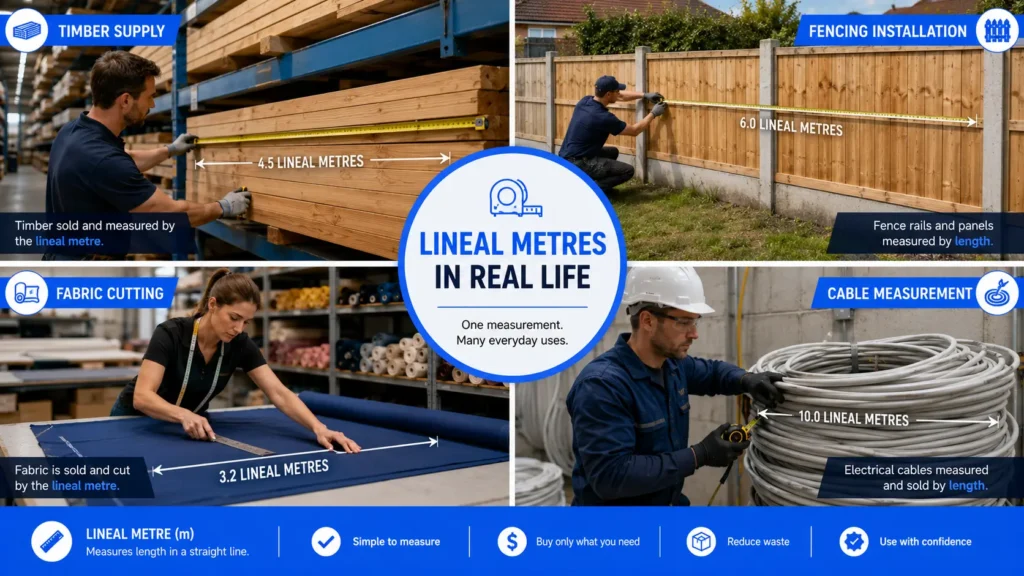
Understanding a lineal metre becomes much easier when you see how it is used in real-life situations. Instead of thinking in abstract terms, it helps to look at how different industries apply this measurement in practical, everyday tasks. These examples show how lineal metres simplify buying, planning, and estimating materials where length is the main concern.
Example 1: Buying Timber
When purchasing timber, suppliers often price materials per lineal metre rather than by area or volume. This is especially common for items like beams, mouldings, and framing lumber where the length determines usage.
- Length-based pricing: You pay for the total length of wood required, regardless of thickness or width
- Project planning: If you need timber for a wall frame or shelving, you measure the total length of all pieces needed and add them together
- Waste allowance: It is common practice to add extra length to account for cuts, mistakes, or offcuts
For example, if your project requires five pieces of timber at 2 metres each, you would need 10 lineal metres in total. This straightforward approach makes it easier to estimate costs and avoid under-ordering.
Example 2: Measuring Fencing
Fencing is one of the most common applications of lineal metre measurements because the main concern is the total boundary length.
- Perimeter calculation: Measure the full length around your property or area to determine how much fencing material you need
- Material estimation: Posts, rails, and panels are often calculated based on total lineal metres
- Cost clarity: Contractors and suppliers typically quote fencing projects per lineal metre for simplicity
For instance, if your property boundary measures 30 metres, you will need 30 lineal metres of fencing. This helps you quickly estimate both materials and labor without complicated calculations.
Example 3: Fabric Or Carpet Rolls
In retail and interior projects, fabrics and carpets are often sold by the lineal metre, particularly when they come in fixed widths.
- Fixed-width materials: The width is predetermined, so you only need to choose the length required
- Custom sizing: You can purchase exactly the length needed for curtains, upholstery, or flooring
- Reduced waste: Buying by lineal metre allows for more precise ordering compared to pre-cut sizes
For example, if a carpet roll is 3 metres wide and you purchase 4 lineal metres, you are getting a piece that is 3 metres by 4 metres. Understanding this helps prevent confusion between lineal and square measurements.
Example 4: Pipes And Cables
Pipes, electrical cables, and wiring are almost always measured and sold in lineal metres because they are installed in continuous lengths.
- Installation efficiency: Contractors measure the required run from one point to another and order the exact length needed
- Flexible usage: Materials can be cut on-site to fit specific layouts or systems
- Accurate budgeting: Knowing the total length helps estimate both material costs and installation time
For example, if you need to run a cable from a power source to a device 15 metres away, you would purchase at least 15 lineal metres, often with a small allowance for adjustments.
In all of these scenarios, the key takeaway is that a lineal metre focuses purely on length, making it a practical and easy-to-use measurement for many real-world applications.
When Should You Use Lineal Metres?
Understanding when to use lineal metres is key to avoiding measurement errors, wasted materials, and unnecessary costs. This unit is straightforward once you know its purpose, but using it in the wrong context can lead to confusion. The goal is to match the measurement method to what you are actually trying to calculate.
Situations Where Length Is the Only Concern
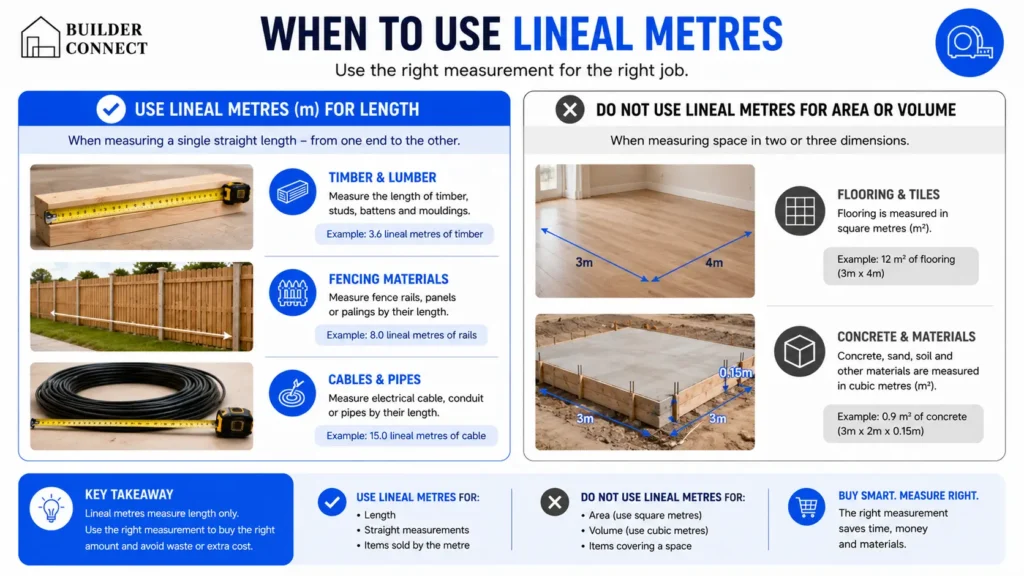
Lineal metres are used when you only need to measure how long something is, regardless of its width, thickness, or depth. This is common in many real-world scenarios where materials are supplied in continuous lengths.
- Construction materials: Items like timber, steel bars, pipes, and beams are often sold based on length because their cross-section remains consistent.
- Fencing and boundaries: When installing fences or edging, the total distance around a property is what matters, not the surface area.
- Fabric and textiles: Materials such as fabric or carpet rolls are measured by length, while the width is typically fixed and predefined.
- Cables and wiring: Electrical cables and networking wires are purchased based on how far they need to run from one point to another.
- Trim and finishing materials: Skirting boards, mouldings, and trims are measured in lineal metres because they follow the perimeter of a space.
In all these cases, the width or thickness is either standard or irrelevant to the calculation, making lineal metres the most practical choice.
When NOT To Use Lineal Metres
Lineal metres should not be used when the size of a surface or the space occupied by a material is important. In these cases, using the wrong measurement type can result in ordering too much or too little material.
- Flooring and tiling: These require square-metre calculations because you are covering a surface area, not just measuring length.
- Painting and wall coverage: Paint quantities depend on the total wall area, not the perimeter length alone.
- Concrete and bulk materials: When dealing with volume, such as concrete, soil, or gravel, cubic metres are the correct unit.
- Insulation and panels: Products designed to cover surfaces must be calculated using area-based measurements to ensure full coverage.
A simple rule is that if the material needs to cover a space rather than follow a line, lineal metres are not the right choice.
How To Choose The Correct Measurement Type
Choosing the correct measurement depends on what you are trying to achieve and how the material will be used. Taking a moment to assess the project can prevent costly mistakes.
- Purpose-based decision: Ask whether you are measuring a straight run or covering a surface. Straight runs use lineal metres, while surfaces require square metres.
- Material type: Check how the supplier lists the product. If it is sold by length, lineal metres are appropriate. If sold by area or volume, use the corresponding unit.
- Project layout: Consider whether the material follows edges, boundaries, or paths. If it does, lineal metres are typically the correct measurement.
- Conversion awareness: If you only have area measurements but need length, ensure you know the width before converting to avoid inaccurate results.
Making the right choice comes down to understanding the difference between length, area, and volume, and applying the correct unit based on the task at hand.
Using lineal metres correctly makes planning and purchasing far more straightforward, especially for projects that involve continuous lengths, and it helps ensure you get exactly what you need without unnecessary waste or confusion.
Common Questions About Lineal Metres
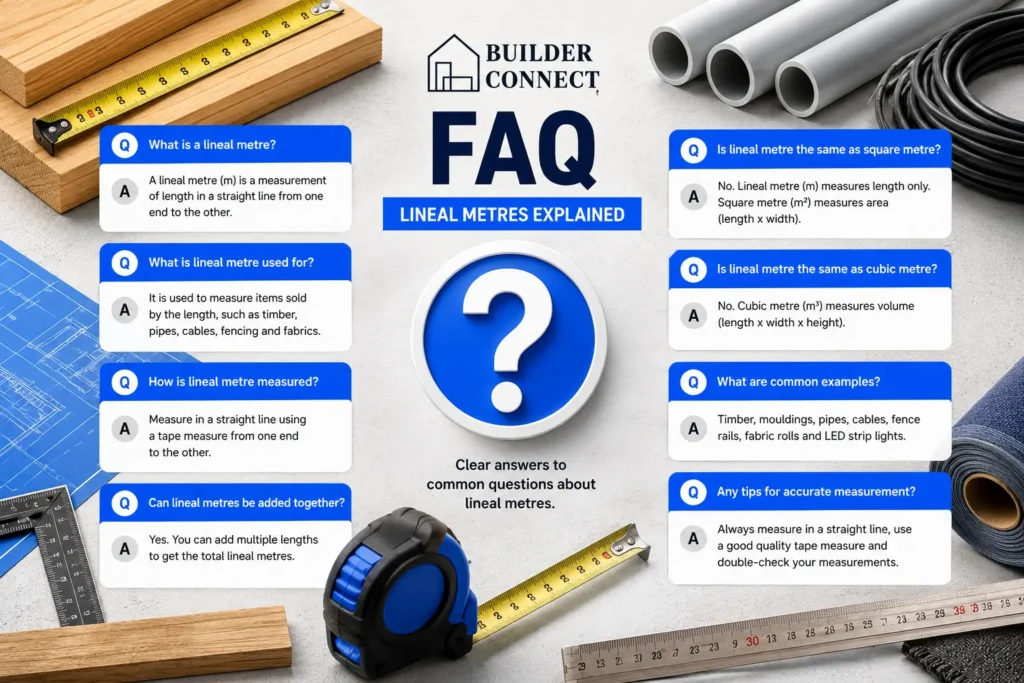
Understanding how lineal metres work becomes much easier once you address the most common questions people have. These are the points that often cause confusion when measuring materials, ordering supplies, or planning projects. Clarifying them helps you avoid mistakes and apply the concept correctly in real-world situations.
Is A Lineal Metre Always 1 Metre?
Yes, a lineal metre is always equal to exactly one metre in length. It is a fixed unit of measurement, just like a standard metre, and it does not change based on the type of material being measured.
- Definition clarity: A lineal metre simply represents one metre measured in a straight line, regardless of what is being measured.
- Consistency across uses: Whether you are measuring timber, fabric, or fencing, one lineal metre always equals one metre in length.
- No hidden variables: Unlike area or volume measurements, there are no additional dimensions involved, which keeps it straightforward and reliable.
This consistency is what makes lineal metres useful in industries where only length matters.
Does Width Or Thickness Matter?
Width and thickness do not affect the measurement of a lineal metre, but they can still influence how the material is used and priced. This is where many people get confused when comparing products.
- Measurement focus: A lineal metre measures length only, so width and thickness are not included in the calculation.
- Practical importance: Even though they do not affect the measurement, width and thickness still matter for functionality, strength, and coverage.
- Pricing differences: Some suppliers may charge differently based on material size or quality, even if the lineal metre measurement stays the same.
For example, one lineal metre of narrow timber and one lineal metre of wide timber are the same length, but they serve different purposes and may cost different amounts.
Why Do Suppliers Use Lineal Metres Instead Of Square Metres?
Suppliers use lineal metres because it simplifies the buying and selling process for long, continuous materials. It allows customers to focus on length without needing to calculate area.
- Ease of measurement: Measuring length is quicker and more practical for items like pipes, cables, or beams.
- Industry standard: Many construction and manufacturing materials are produced and sold in fixed widths, making length the most relevant measurement.
- Reduced complexity: Using square metres would require factoring in width, which is unnecessary when the product already has a standard size.
This approach makes transactions more efficient and reduces the risk of ordering incorrect quantities.
Is Lineal Metre Used Worldwide Or Region-Specific?
Lineal metre is widely used in countries that follow the metric system, but terminology and measurement practices can vary depending on the region and industry.
- Metric-system regions: Countries like Australia, the UK, and most of Europe commonly use lineal or linear metres in construction and retail.
- Alternative systems: In countries that use imperial measurements, such as the United States, length is often measured in feet or yards instead.
- Terminology variation: Some regions prefer the term linear metre, but both refer to the same concept and are generally understood across industries.
If you are working across different regions, it is always a good idea to confirm the measurement system being used to avoid confusion.
Understanding these common questions helps you apply lineal metre measurements with confidence, whether you are planning a project, comparing materials, or working with suppliers.
Tips For Measuring Accurately
Getting your measurements right is essential when working with lineal metres, especially in construction, DIY projects, or material purchasing. Even small errors can lead to wasted materials, added costs, or project delays. By using the right tools and following a careful, step-by-step approach, you can ensure your measurements are precise, reliable, and fit for purpose.
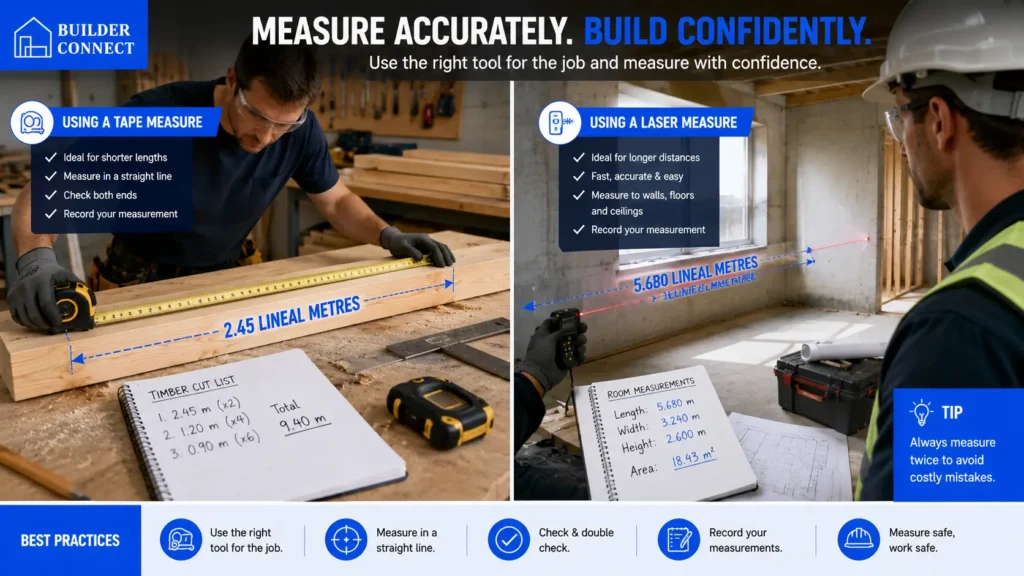
Tools To Use (Tape Measure, Laser Measure)
Choosing the right measuring tool can make a significant difference in accuracy and efficiency. Different tools are suited for different types of projects, so it is important to understand when to use each one.
- Tape measure: Ideal for short-to-medium distances and everyday use, a tape measure is flexible, easy to handle, and suitable for measuring timber, fabric, or small spaces.
- Laser measure: Best for long-distance measurements or large spaces, a laser measure provides quick, highly accurate readings with minimal effort. It is especially useful for construction sites or outdoor projects.
- Measuring wheel: Useful for large outdoor areas such as fencing or landscaping, this tool helps measure long, continuous distances with ease.
Using a well-maintained tool and ensuring it is properly aligned before measuring will help prevent small inaccuracies that can add up over time.
Double-Checking Measurements
Even experienced professionals make mistakes, which is why double-checking is a simple but essential step. Measuring twice ensures that any errors are caught early before materials are cut or ordered.
- Repeat measurements: Measure the same length at least twice to confirm consistency.
- Check from different points: Measure from both ends or different reference points to verify accuracy.
- Record clearly: Write down measurements immediately to avoid confusion or memory errors later.
This habit is especially important when working on high-cost materials or projects where precision is critical.
Allowing For Waste Or Extra Material
Accurate measuring is not just about getting the exact length, it is also about planning for real-world conditions where some material loss is unavoidable.
- Cutting allowance: Materials like timber or fabric often require trimming, which reduces usable length.
- Installation adjustments: Fitting materials into uneven spaces may require slight modifications.
- Safety margin: Adding an extra 5 to 10 percent helps cover unexpected errors or changes during installation.
Planning for waste ensures that you do not run short mid-project, which can be both costly and time-consuming.
Avoiding Costly Ordering Mistakes
Incorrect measurements often lead to ordering too much or too little material, both of which can impact your budget and timeline. Taking a structured approach helps minimize these risks.
- Understand measurement type: Confirm whether the supplier uses lineal metres, square metres, or another unit to avoid confusion.
- Verify product specifications: Check width, thickness, and packaging details, as these can affect how much material you actually need.
- Consult suppliers if unsure: Asking questions before ordering can prevent misunderstandings and ensure you get the correct quantity.
By combining careful measurement with clear communication, you can avoid unnecessary expenses and keep your project on track.
Accurate measuring is a simple skill that can make a significant difference in the success of any project, helping you save time, reduce waste, and make confident purchasing decisions.
References
- What Is a Linear Metre? A Clear Guide to Length, Quotes and Usage
https://www.somners.com/resources/linearmetre (somners.com) - What Is a Linear Meter and How to Calculate It
https://learningshared.com.au/what-is-a-linear-meter/ (learningshared.com.au) - What Is a Linear Metre? Definition and Practical Uses
https://buildsearch.com.au/what-is-a-linear-metre (BuildSearch) - What Is a Linear Metre? Guide for Construction and DIY
https://www.realestate.com.au/advice/what-is-a-linear-metre/ (Realestate) - Linear Meter Definition and Measurement Explanation
https://turncalculator.com/linear-meter-calculator.php (turncalculator.com)
FAQs: About What Is A Lineal Metre
Conclusion
Understanding what a lineal metre is does not have to be complicated, and once you grasp that it simply refers to length measured in a straight line, it becomes a practical, easy-to-use concept in everyday situations. Whether you are working on a home-improvement project, ordering materials, or planning a build, knowing when to use a lineal metre helps you avoid costly mistakes and ensures you get accurate measurements the first time. It is especially useful when dealing with long, continuous materials like timber, fencing, fabric, or piping, where only length matters. With this knowledge, you can approach measurements with more confidence, make better purchasing decisions, and communicate clearly with suppliers or contractors. If you are planning a project, measure your space carefully and calculate your lineal metres before buying materials, and consider using reliable measurement calculators or DIY planning tools to make the process even easier and more precise.
Find A Professional Builders Company Near You!
- Auckland Builders For Small Jobs
- Builders Alexandra
- Builders Ashburton
- Builders Auckland
- Builders Blenheim
- Builders Cambridge
- Builders Central Otago
- Builders Christchurch
- Builders Clyde
- Builders Cromwell
- Builders Dunedin
- Builders Feilding
- Builders Gisborne
- Builders Hamilton
- Builders Hastings
- Builders Havelock North
- Builders Hawkes Bay
- Builders Hibiscus Coast
- Builders Invercargill
- Builders Johnsonville
- Builders Kapiti
- Builders Kerikeri
- Builders Levin
- Builders Lower Hutt
- Builders Manawatu
- Builders Masterton
- Builders Mosgiel
- Builders Napier
- Builders Nelson
- Builders New Plymouth
- Builders Oamaru
- Builders Paihia
- Builders Palmerston North
- Builders Paraparaumu
- Builders Porirua
- Builders Pukekohe
- Builders Queenstown
- Builders Rangiora
- Builders Rolleston
- Builders Taupo
- Builders Tauranga
- Builders Te Awamutu
- Builders Timaru
- Builders Tokoroa
- Builders Upper Hutt
- Builders Waikanae
- Builders Wanaka
- Builders Warkworth
- Builders Wellington
- Builders West Auckland
- Builders Whakatane
- Builders Whanganui
- Builders Whangarei
- Handyman Wellington
- Home Builders Rotorua
- Kitchen Removal Service Auckland
- Wellington Builders For Small Jobs

About the Author:
Mike Veail is a recognized digital marketing expert with over 6 years of experience in helping tradespeople and small businesses thrive online. A former quantity surveyor, Mike combines deep industry knowledge with hands-on expertise in SEO and Google Ads. His marketing strategies are tailored to the specific needs of the trades sector, helping businesses increase visibility and generate more leads through proven, ethical methods.
Mike has successfully partnered with numerous companies, establishing a track record of delivering measurable results. His work has been featured across various platforms that showcase his expertise in lead generation and online marketing for the trades sector.
Learn more about Mike's experience and services at https://theleadguy.online or follow him on social media: