Welcome to this straightforward guide on what a PC Sum (Prime Cost Sum) is and why it matters when reviewing building quotes or renovation budgets, where confusing terms can often lead to costly surprises if misunderstood. In this article, you’ll learn exactly how PC sums work, why builders use them, how they impact your final costs, and what you can do to stay in control of your budget, giving you the clarity and confidence to make smarter, more informed decisions before signing any contract.
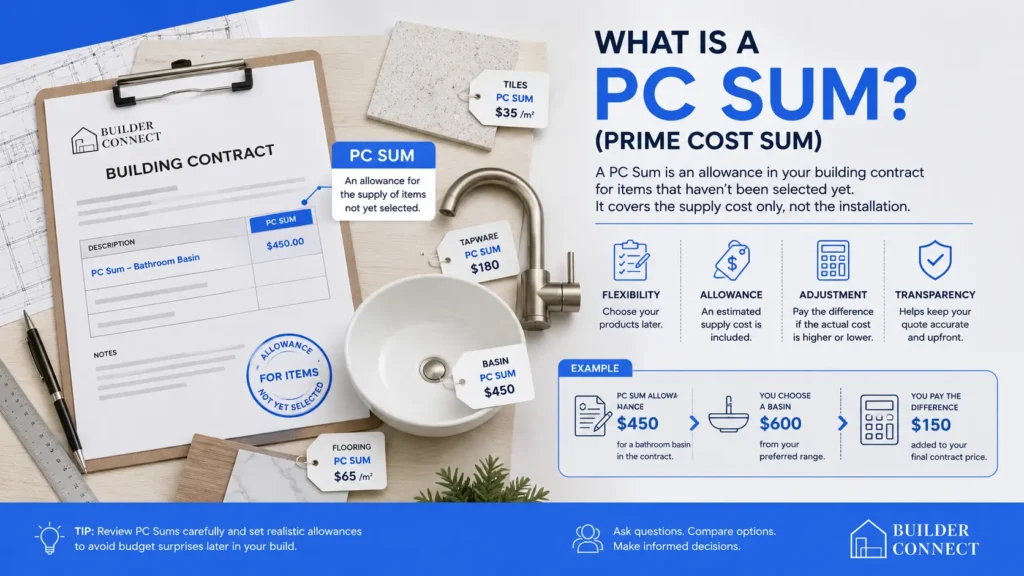
A PC Sum (Prime Cost Sum) is an allowance in a construction contract for the supply of items not yet selected, such as fixtures or fittings. It covers estimated material costs only, meaning the final price may change depending on the actual products chosen during the build.
- What Is A PC Sum (Prime Cost Sum)?
- Why Do Builders Use Prime Cost Sums?
- What’s Included (And Not Included) In A PC Sum?
- PC Sum Vs Provisional Sum: What’s The Difference?
- How Prime Cost Sums Affect Your Budget
- Risks And Common Mistakes To Avoid
- How To Manage PC Sums Effectively
- References
- FAQs: About What Is A PC Sum
- Conclusion
- Find A Professional Builders Company Near You!
What Is A PC Sum (Prime Cost Sum)?
A PC Sum, or Prime Cost Sum, is a commonly used term in construction and renovation contracts that often causes confusion for homeowners. In simple terms, it refers to a pre-agreed allowance set aside for specific items that have not yet been chosen at the time the quote or contract is prepared. Understanding how PC sums work is essential because they directly affect how accurate your initial quote is and how much your final build may cost.
A PC Sum typically appears in building quotes, contracts, and renovation budgets where certain finishes or fixtures are still undecided. Rather than delaying the entire quoting process, builders include an estimated amount so the project can move forward while giving you flexibility to make final selections later.
- Definition: A PC Sum is an estimated allowance in a contract for the supply of items such as fixtures, fittings, or appliances that have not yet been selected.
- Where It Appears: You will usually find PC sums listed in construction quotes, building contracts, and renovation cost breakdowns.
- Key Concept: It covers the supply cost only, meaning the final price may increase or decrease depending on the actual items you choose.
Simple Example Of A Prime Cost Sum
To understand how a PC Sum works in practice, consider a bathroom renovation where you have not yet chosen your fixtures. The builder includes an allowance in the contract to estimate the cost of those items so the project can proceed.
For example, your contract may include a PC Sum of $500 for a toilet. This amount represents a reasonable estimate based on standard options available in the market. However, when it comes time to choose your actual toilet, you might select a model that costs $800.
- Allowance Set: The contract includes a $500 PC Sum for the toilet.
- Actual Selection: You choose a toilet priced at $800.
- Cost Adjustment: You pay the $300 difference on top of the contract price.
This example highlights an important point. PC sums are not fixed costs. They are placeholders that will be adjusted once your final selections are made. If you choose items below the allowance, you may save money, but if you go above it, your total project cost increases.
PC Sum Vs Fixed Price
A key distinction in construction contracts is the difference between PC sums and fixed-price items. Understanding this difference helps you better evaluate quotes and manage your budget expectations.
A fixed-price item is fully defined and agreed upon at the time of signing the contract. The cost is locked in, and there is no variation unless the scope changes. In contrast, a PC Sum is an estimate that can change depending on your selections.
- Estimated Cost: A PC Sum is based on an allowance and can vary depending on what you choose later.
- Locked-In Cost: A fixed price is agreed upfront and does not change unless the contract is modified.
- Flexibility Trade-Off: PC sums offer flexibility in choosing finishes, but they introduce cost uncertainty.
- Budget Impact: Fixed-price items provide cost certainty, while PC sums can lead to increases or savings depending on your decisions.
PC sums create variability in final pricing because they rely on assumptions made early in the project. If those assumptions do not match your actual preferences or expectations, the difference will directly affect your final bill. This is why reviewing PC sums carefully and ensuring they reflect realistic allowances is critical for avoiding unexpected expenses.
Understanding how PC sums work puts you in a stronger position when reviewing quotes, asking informed questions, and making confident decisions about your build or renovation.
Why Do Builders Use Prime Cost Sums?
Prime Cost Sums are a practical tool used in construction contracts to manage uncertainty during the planning and quoting stage. Builders rely on them when certain materials or fixtures have not yet been selected, allowing the project to move forward without delaying timelines. While they introduce some cost variability, they also provide flexibility for both the builder and the homeowner to make decisions at the right stage of the build.
Flexibility When Final Selections Aren’t Made
One of the main reasons builders include Prime Cost Sums is to allow flexibility when clients have not finalized their product choices. At the early stages of a project, many homeowners are still deciding on finishes, fixtures, or fittings, and locking in exact costs too early can be unrealistic.
- Client-driven choices: Homeowners often want time to explore options, compare styles, and visit showrooms before committing to specific products
- Design evolution: As the project progresses, preferences may change based on layout, budget, or new ideas
- Avoiding delays: Including allowances keeps the project moving instead of waiting for every item to be selected upfront
This flexibility ensures that the build can begin while still giving the homeowner control over the final look and feel of their space.
Early-Stage Quoting Limitations
At the quoting stage, builders often work with incomplete information. Detailed specifications for every fixture and fitting may not yet exist, especially in custom builds or renovations. Prime Cost Sums help bridge this gap.
- Incomplete specifications: Not all materials or finishes are defined in early plans
- Time-sensitive quotes: Clients often need a price estimate quickly to make decisions or secure financing
- Market variability: Prices for materials can fluctuate, making exact costing difficult without confirmed selections
By using reasonable allowances, builders can provide a working budget while acknowledging that some costs will be finalized later.
Customization For Homeowners
Modern construction projects are highly personalized, and Prime Cost Sums allow homeowners to tailor their choices without being locked into pre-selected options. This is especially important for clients who value design control and want their home to reflect their preferences.
- Wide product range: Fixtures and fittings come in a broad price spectrum, from budget-friendly to premium options
- Personal style: Homeowners can choose finishes that align with their taste rather than standard inclusions
- Budget flexibility: Clients can decide where to spend more and where to save, depending on priorities
This approach supports a more customized, client-focused building experience while keeping the contract adaptable.
When PC Sums Are Commonly Used
Prime Cost Sums are typically applied to items where there is a wide range of choices and pricing, making it difficult to assign a fixed cost early on. These are usually visible, design-focused elements that homeowners prefer to select themselves.
Bathrooms (Toilets, Taps, Tiles)
Bathrooms are one of the most common areas where PC sums are used because of the variety of available fixtures and finishes.
- Fixture selection: Toilets, basins, and tapware can vary significantly in price and style
- Tile choices: Tiles range from basic ceramic options to high-end designer materials
- Aesthetic impact: These elements play a major role in the overall look and feel of the space
Kitchens (Appliances, Cabinetry Fittings)
Kitchens involve multiple components that are often selected later in the process, making them ideal for Prime Cost allowances.
- Appliance range: Ovens, cooktops, and dishwashers come in a wide range of brands and price points
- Hardware options: Cabinet handles, hinges, and internal fittings can vary in quality and cost
- Functional upgrades: Homeowners may choose to upgrade features based on lifestyle needs
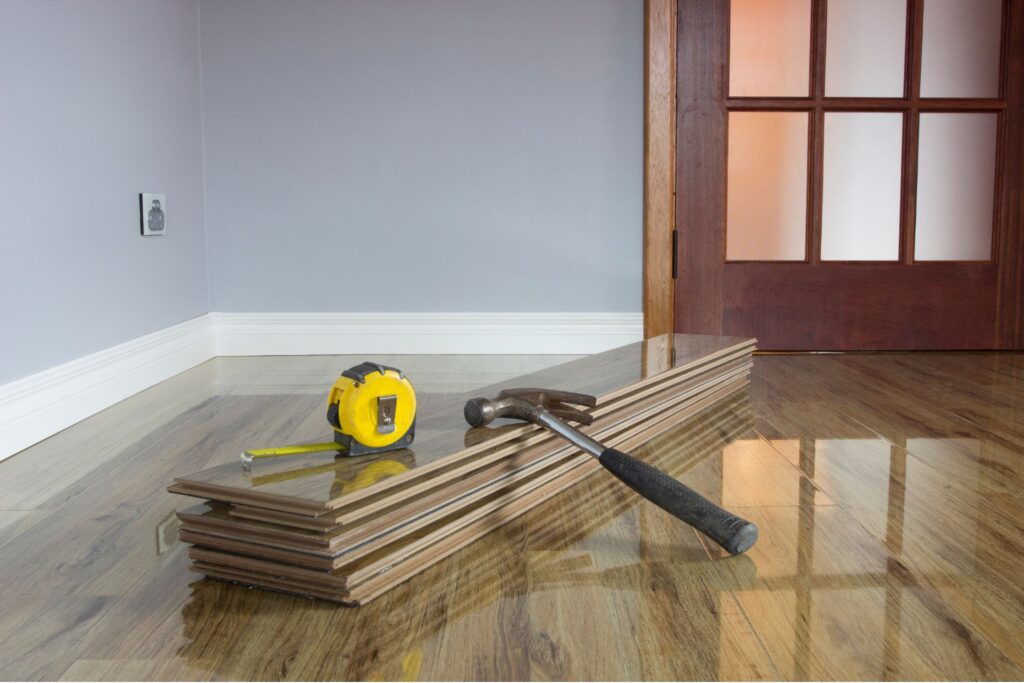
Flooring And Finishes
Flooring and surface finishes are another area where preferences can vary widely, making fixed pricing difficult at the start.
- Material variety: Options include tiles, timber, laminate, and vinyl, each with different price levels
- Finish preferences: Color, texture, and durability all influence final selection
- Project scope: Different areas of the home may require different flooring types, adding complexity to early costing
Prime Cost Sums in these areas allow for flexibility while ensuring the builder can provide a realistic starting estimate.
Understanding why builders use Prime Cost Sums helps you approach your building contract with more clarity and confidence, making it easier to manage expectations and avoid unexpected costs as your project progresses.

What’s Included (And Not Included) In A PC Sum?
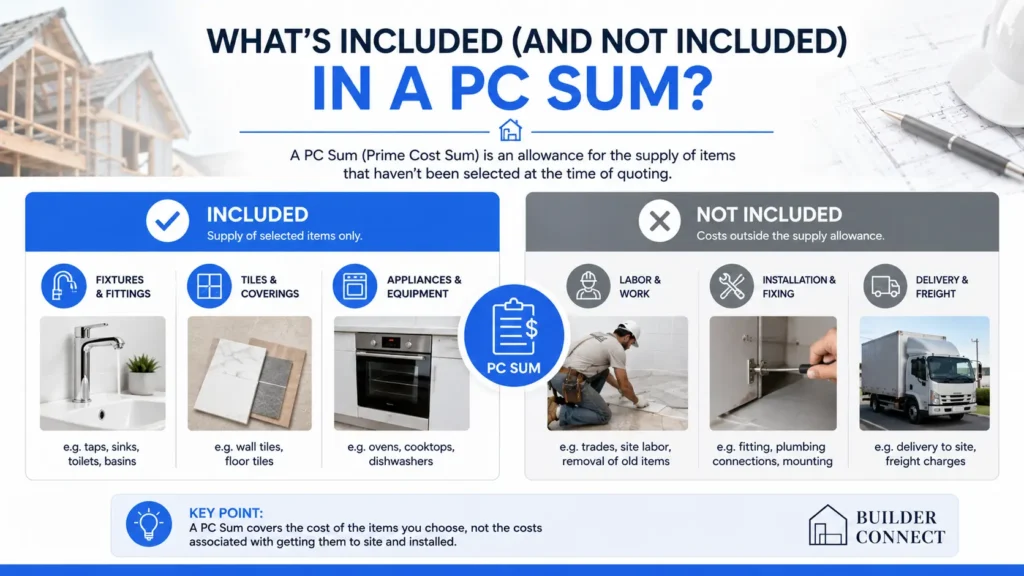
Understanding exactly what a PC Sum covers is essential if you want to avoid budget surprises during a build or renovation. A Prime Cost Sum is generally a material-only allowance set aside for items that haven’t been selected yet, which means it focuses on the supply of products rather than the full cost of getting them installed and ready to use. This distinction often catches people off guard, especially when reviewing a seemingly competitive quote.
What Is Usually Included
A PC Sum typically includes the supply cost of specific fixtures and fittings that will be chosen later in the project. These are the visible, finish-level items that define the look and functionality of a space but are often undecided at the quoting stage.
- Fixtures and fittings: These include items such as sinks, taps, toilets, bathtubs, tiles, door handles, and kitchen appliances. The allowance is usually based on a mid-range estimate unless otherwise specified.
- Standard product selection: Builders often base the allowance on commonly used or entry-to-mid-level products available from their preferred suppliers, which may not reflect premium choices.
- Supply-only pricing: The figure allocated represents the purchase price of the item itself, excluding any costs associated with installation or adjustments.
In practice, this means if you later choose a higher-end tapware set or designer tiles, the difference between the allowance and the actual purchase price will be added to your contract.
What Is Usually NOT Included
While PC Sums help estimate material costs, they do not account for the full scope of work required to install and complete those items. This is where misunderstandings often lead to unexpected expenses.
- Labor and installation costs: The cost of installing the item, including plumbing, electrical work, or carpentry, is typically not part of the PC Sum and is handled separately in the contract.
- Preparation or modification work: Any additional work needed to fit a chosen item, such as resizing cabinetry or adjusting plumbing connections, is not included unless specifically stated.
- Delivery or special handling: In some cases, delivery fees, crane hire, or handling for heavy or fragile items are excluded, especially if they go beyond standard supplier arrangements.
- Upgrades or custom orders: If you select custom-made or imported items, any extra costs related to sourcing, shipping, or delays are usually outside the original allowance.
Being clear on these exclusions allows you to read a building quote more accurately and ask the right questions before committing. A well-informed approach helps ensure your budget reflects the true cost of your selections rather than just the initial allowance.
In the end, knowing what is and is not included in a PC Sum gives you far better control over your project costs and helps you avoid the common trap of underestimating the final price.
PC Sum Vs Provisional Sum: What’s The Difference?
Understanding the difference between a PC Sum and a Provisional Sum is essential if you want to avoid unexpected costs in a construction project. While both are allowances used in building contracts, they serve different purposes and carry different levels of cost uncertainty. Knowing how each one works will help you read quotes more accurately and make better financial decisions before construction begins.
Definition Of Provisional Sum
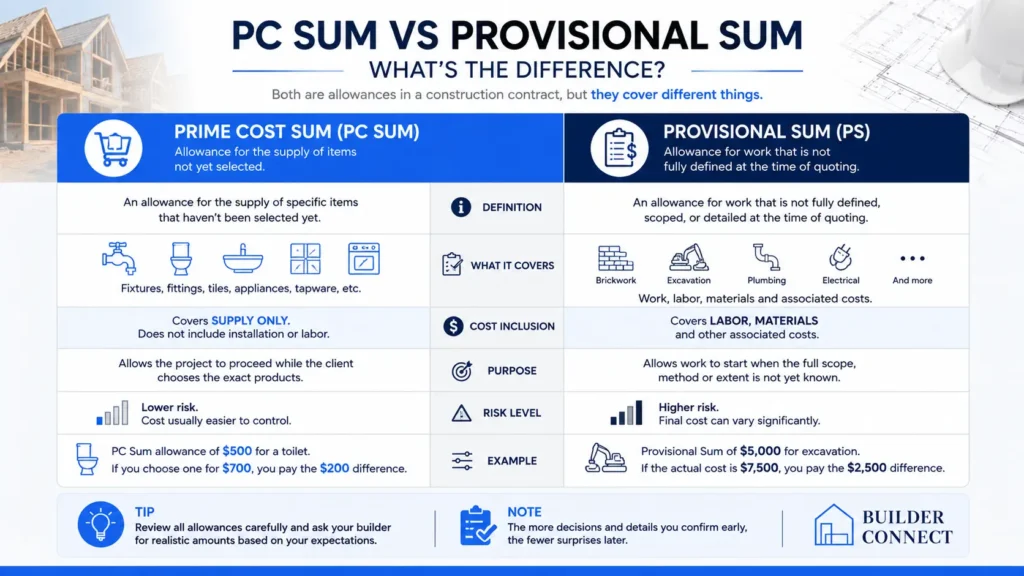
A Provisional Sum is an estimated allowance in a building contract that covers both the supply of materials and the labor required to complete a specific part of the work. It is typically used when the full scope of that work has not yet been clearly defined at the time the quote is prepared.
In practical terms, this means the builder cannot accurately price that portion of the job because key details are still unknown. For example, excavation work is often listed as a Provisional Sum because the actual site conditions may not be fully understood until work begins. As a result, the final cost may increase or decrease depending on what is discovered during construction.
- Scope-based estimate: A Provisional Sum is used when the builder cannot determine the exact requirements of a task upfront
- Includes labor and materials: Unlike PC sums, this allowance covers the complete cost of completing the work
- Higher variability: The final price is more likely to change due to unknown site conditions or design changes
Key Differences At A Glance
Although PC Sums and Provisional Sums may look similar in a contract, they represent very different types of allowances. The distinction comes down to what is being estimated and how much control you have over the final cost.
| Allowance Type | What It Covers | Cost Certainty | Example |
| PC Sum | Supply only | Moderate | Tiles, taps, appliances |
| Provisional Sum | Supply + labor | Low | Excavation, structural work |
PC Sum: Covers the cost of specific items that have not yet been selected, such as fixtures or fittings, but does not include installation- Provisional Sum: Covers an entire portion of work where both materials and labor are uncertain
- Control level: You have more control over PC sums because you choose the products, while Provisional Sums depend more on site conditions and builder execution
- Cost predictability: PC sums are generally easier to estimate accurately compared to Provisional Sums
Why This Difference Matters
The difference between these two allowances directly affects how accurately you can plan your budget and how much financial risk you take on during a project. Many homeowners focus only on the total contract price without realizing that these allowances can significantly change the final cost.
- Budget accuracy: PC sums allow for more predictable budgeting because you can research product prices and make informed selections early
- Risk exposure: Provisional Sums carry a higher level of risk since costs can increase due to factors outside your control, such as ground conditions or design complexity
- Quote comparison: A quote with many Provisional Sums may appear competitive but can end up costing more once actual work begins
- Decision-making: Understanding the difference helps you ask better questions, negotiate clearer terms, and reduce uncertainty before signing a contract
Ultimately, recognizing how PC Sums and Provisional Sums work gives you greater confidence and control over your building project, helping you avoid unexpected costs and make smarter financial decisions from the outset.
How Prime Cost Sums Affect Your Budget
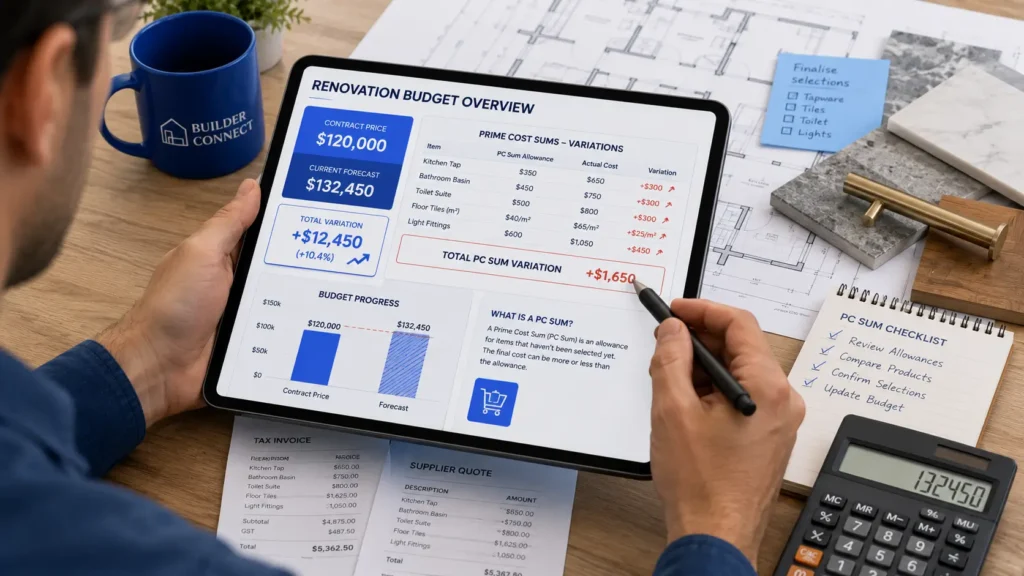
Prime Cost Sums introduce a level of flexibility into your building contract, but that flexibility comes with cost variability. Because these sums are only estimates for items not yet selected, the final amount you pay can shift depending on your choices. This means your initial quote may not reflect the true end cost of your project, making it essential to understand how these allowances work and where budget changes typically occur.
Why PC Sums Can Increase Final Costs
One of the most common reasons homeowners exceed their budget is due to how Prime Cost Sums are initially set and later adjusted. While they are intended to provide a placeholder for unknown selections, they can often be underestimated or misaligned with your expectations.
- Underestimated allowances: Builders may include low-to-mid-range estimates to keep the overall quote competitive, but these figures might not match the quality or style you have in mind. For example, a bathroom fixture allowance might cover a basic model, while your preference leans toward premium fittings, resulting in additional costs.
- Upgrades during selection: As you move through the selection process, it is natural to choose higher-quality or more visually appealing items. These upgrades, while improving the final outcome, often exceed the original allowance and increase the total contract price.
Understanding these two factors early can help you make more informed decisions and avoid unexpected financial pressure later in the project.
Real Cost Breakdown Example
To better understand how Prime Cost Sums impact your final budget, it helps to look at a simple, real-world scenario that illustrates how costs can change from estimate to actual purchase.
- Allowance vs actual purchase: Imagine your contract includes a Prime Cost Sum of $500 for a kitchen sink. When you begin selecting your fixtures, you find a sink that meets your design and durability expectations, but it costs $800. The original allowance no longer reflects your actual choice.
- Difference added to contract: The $300 difference between the allowance and your selected item is added to your contract price. Depending on your agreement, this adjustment may also include additional costs such as supplier margins or handling fees, further increasing the final amount.
This type of cost adjustment can occur across multiple items in your project, which is why even small differences can add up quickly if not carefully managed.
By understanding how Prime Cost Sums function and where cost increases typically arise, you can take a more proactive approach to budgeting, make selections with confidence, and reduce the risk of unexpected expenses throughout your build.
Risks And Common Mistakes To Avoid
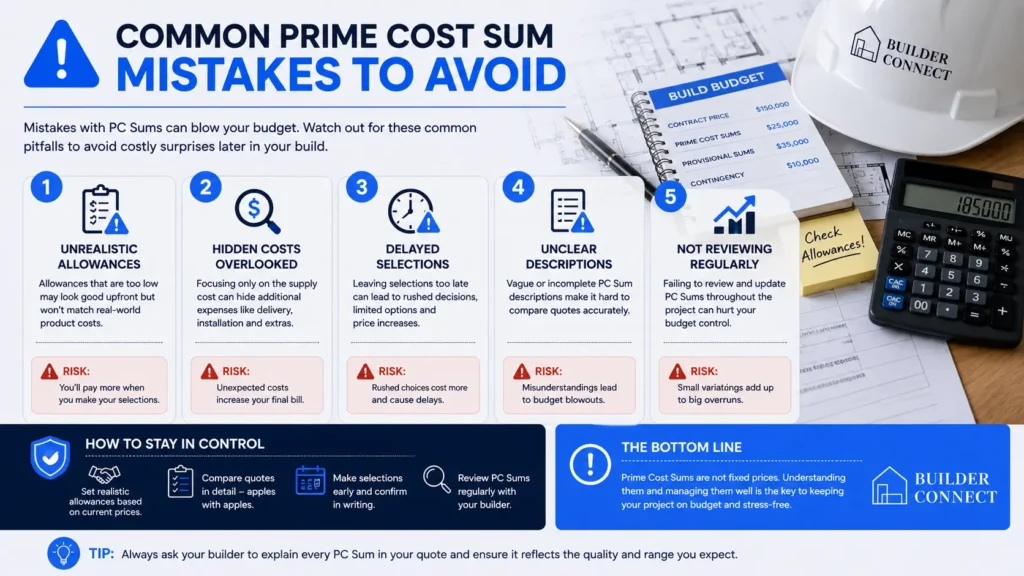
Understanding how Prime Cost Sums work is only part of the equation. The real challenge lies in how they are applied within a building quote and how easily they can lead to unexpected costs if not managed properly. Based on real-world construction experience, most budget issues tied to PC sums come down to a few common but avoidable mistakes.
Choosing Unrealistically Low Allowances
One of the most frequent issues in building contracts is the use of low-cost allowances that make a quote appear more competitive than it actually is. While this may not always be intentional, it can significantly distort the true cost of your project.
- Budget distortion: A low PC sum creates the illusion of a cheaper overall build, but once you select mid-range or high-quality items, the final price increases quickly.
- Limited product options: Unrealistically low allowances often restrict you to entry-level products that may not match your expectations or the overall quality of your build.
- Upgrade pressure: Homeowners often feel compelled to upgrade during the selection stage, which leads to cumulative cost increases across multiple items.
In practice, experienced builders will aim to include realistic, market-aligned allowances. If a quote seems significantly lower than others, it is worth reviewing the PC sums closely to understand where compromises may have been made.
Not Understanding What’s Included
Another common mistake is assuming that a PC sum covers more than it actually does. This misunderstanding often leads to hidden-cost surprises once the project is underway.
- Material-only coverage: Most PC sums include supply costs only, meaning installation, labor, and additional materials are charged separately.
- Exclusions not clarified: Items like delivery fees, fittings, or accessories may not be included unless clearly stated in the contract.
- Assumption gaps: Without a detailed breakdown, homeowners may assume a complete solution is covered when only a basic component is allowed for.
To avoid confusion, always request a detailed scope of what each PC sum includes. A transparent, itemized quote helps eliminate guesswork and gives you a clearer picture of your true costs.
Making Late Selections
Delaying product selections is another risk that can impact both your budget and your project timeline. While PC sums are designed to provide flexibility, leaving decisions too late often creates avoidable complications.
- Price variability: Costs may change between the time of quoting and the time of purchase, especially in fluctuating markets.
- Project delays: Waiting on selections can hold up construction progress, particularly if items need to be ordered or customized.
- Reduced choice: Limited availability or time pressure may force you to choose from what is in stock rather than what you actually want.
From a project-management perspective, early decision-making is one of the most effective ways to stay on budget and on schedule. Finalizing selections upfront allows your builder to lock in pricing and plan more efficiently.
Being aware of these risks puts you in a stronger position to review quotes critically, ask the right questions, and make informed decisions that protect your budget throughout the build.
How To Manage PC Sums Effectively
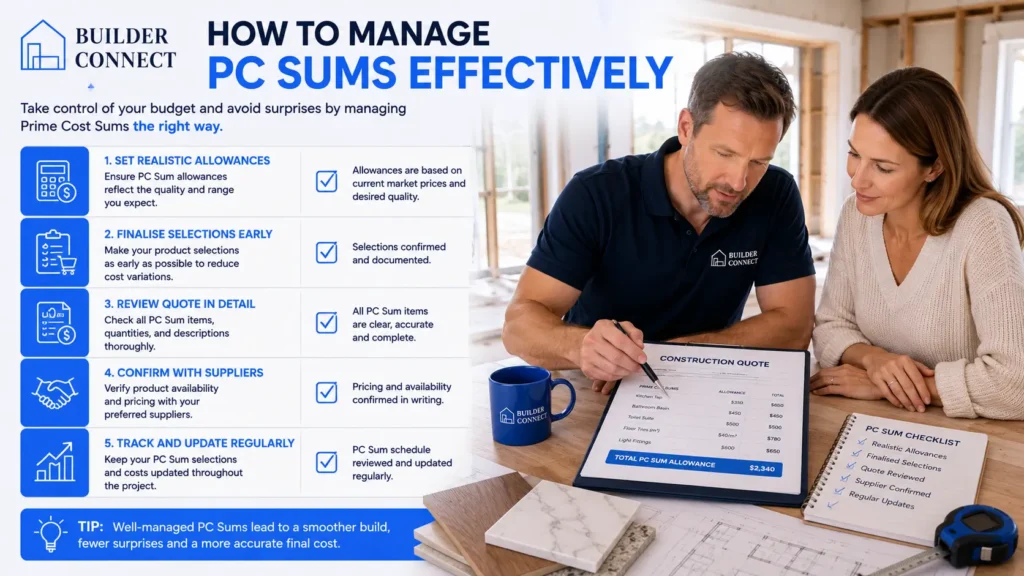
Managing PC sums properly can make a significant difference in how accurately your project stays within budget. While these allowances are a normal part of many construction contracts, they require active oversight and informed decision-making to avoid unexpected costs. By taking a proactive approach and understanding how these allowances work in real-world scenarios, you can reduce financial risk and maintain better control over your build.
Request Realistic Allowances
One of the most common issues with PC sums is that the initial allowance may not reflect the quality or style you actually want. Builders sometimes include low-end figures to keep quotes competitive, which can lead to budget increases later when selections are finalized.
- Market comparison: Review current retail prices for items like fixtures, tiles, or appliances to understand whether the allowance aligns with realistic costs in your area
- Mid-range benchmarks: Ask your builder to base allowances on mid-range products rather than entry-level options, especially if your expectations are higher than basic finishes
- Specification clarity: Confirm what type of products the allowance is based on, including brand, quality level, and features, to avoid mismatched expectations
Finalize Selections Early
Delaying product selections is one of the main reasons PC sums lead to cost variations. The earlier you make decisions, the easier it is to convert allowances into fixed prices and reduce uncertainty.
- Budget control: Early selections allow accurate pricing, helping you avoid last-minute upgrades that increase costs
- Project efficiency: Locking in choices reduces delays caused by out-of-stock items or late design changes
- Contract certainty: Replacing PC sums with confirmed costs creates a more predictable and stable contract value
Ask For Detailed Breakdowns
Transparency is essential when dealing with PC sums. A vague allowance can make it difficult to understand what you are actually paying for and whether the figure is reasonable.
- Itemized inclusions: Request a clear list of what each PC sum covers, including product type, quantity, and assumed quality level
- Cost assumptions: Ask how the allowance was calculated and whether it reflects current supplier pricing
- Variation process: Understand how cost differences will be handled if your selections come in above or below the allowance
Work With Trusted Suppliers
The suppliers involved in your project can directly influence both quality and pricing consistency. Working with reputable vendors helps ensure that the allowances used are realistic and that product availability is reliable.
- Consistent pricing: Established suppliers are more likely to provide stable, transparent pricing that aligns with your contract allowances
- Product reliability: Trusted brands and suppliers reduce the risk of defects, delays, or substitutions that can impact costs
- Better guidance: Experienced suppliers can recommend products within your budget range, helping you stay aligned with your PC sum allowances
Taking control of PC sums is less about eliminating them and more about managing them with clarity and intention, so you can move through your project with confidence and fewer financial surprises.
References
- Prime Cost Sums in Construction Contracts: Risks, BOQ Examples, and Pricing Strategy
https://quollnet.com/article/prime-cost-sums-construction (Quollnet) - What Is The Prime Cost Sum In Construction?
https://www.hpdconsult.com/what-is-the-prime-cost-sum-in-construction/ (HPD TEAM) - Understanding Provisional Sums and Prime Cost Items in Construction
https://colemangreig.com.au/insights/publications/what-are-provisional-sums-and-prime-cost-items-in-construction/ (Coleman Greig Lawyers) - Understanding Prime Cost Sums in Construction Contracts
https://proventus.uk/understanding-prime-cost-sums-in-construction-contracts/ (Proventus) - Prime Costs and Provisional Sums Explained
https://www.mbawa.com/prime-costs-and-provisional-sums/ (mbawa.com)
FAQs: About What Is A PC Sum
Conclusion
Building or renovating doesn’t have to feel uncertain or overwhelming when you approach it with the right level of clarity and preparation, and understanding how allowances like PC sums work is a big part of staying in control of your budget from start to finish. The key is to slow down at the quote-review stage, look closely at every allowance, and make sure the figures reflect your real expectations rather than best-case assumptions, because small gaps early on can quickly turn into significant cost increases later. Take the time to ask direct questions about what is included, request realistic estimates, and don’t hesitate to seek expert guidance if something feels unclear, as this is where many costly mistakes can be avoided. If you want to move forward with confidence, consider using a detailed building-quote checklist or speaking with a construction professional before signing your contract, so you can make informed decisions and avoid unnecessary surprises along the way.
Find A Professional Builders Company Near You!
- Auckland Builders For Small Jobs
- Builders Alexandra
- Builders Ashburton
- Builders Auckland
- Builders Blenheim
- Builders Cambridge
- Builders Central Otago
- Builders Christchurch
- Builders Clyde
- Builders Cromwell
- Builders Dunedin
- Builders Feilding
- Builders Gisborne
- Builders Hamilton
- Builders Hastings
- Builders Havelock North
- Builders Hawkes Bay
- Builders Hibiscus Coast
- Builders Invercargill
- Builders Johnsonville
- Builders Kapiti
- Builders Kerikeri
- Builders Levin
- Builders Lower Hutt
- Builders Manawatu
- Builders Masterton
- Builders Mosgiel
- Builders Napier
- Builders Nelson
- Builders New Plymouth
- Builders Oamaru
- Builders Paihia
- Builders Palmerston North
- Builders Paraparaumu
- Builders Porirua
- Builders Pukekohe
- Builders Queenstown
- Builders Rangiora
- Builders Rolleston
- Builders Taupo
- Builders Tauranga
- Builders Te Awamutu
- Builders Timaru
- Builders Tokoroa
- Builders Upper Hutt
- Builders Waikanae
- Builders Wanaka
- Builders Warkworth
- Builders Wellington
- Builders West Auckland
- Builders Whakatane
- Builders Whanganui
- Builders Whangarei
- Handyman Wellington
- Home Builders Rotorua
- Kitchen Removal Service Auckland
- Wellington Builders For Small Jobs

About the Author:
Mike Veail is a recognized digital marketing expert with over 6 years of experience in helping tradespeople and small businesses thrive online. A former quantity surveyor, Mike combines deep industry knowledge with hands-on expertise in SEO and Google Ads. His marketing strategies are tailored to the specific needs of the trades sector, helping businesses increase visibility and generate more leads through proven, ethical methods.
Mike has successfully partnered with numerous companies, establishing a track record of delivering measurable results. His work has been featured across various platforms that showcase his expertise in lead generation and online marketing for the trades sector.
Learn more about Mike's experience and services at https://theleadguy.online or follow him on social media: